


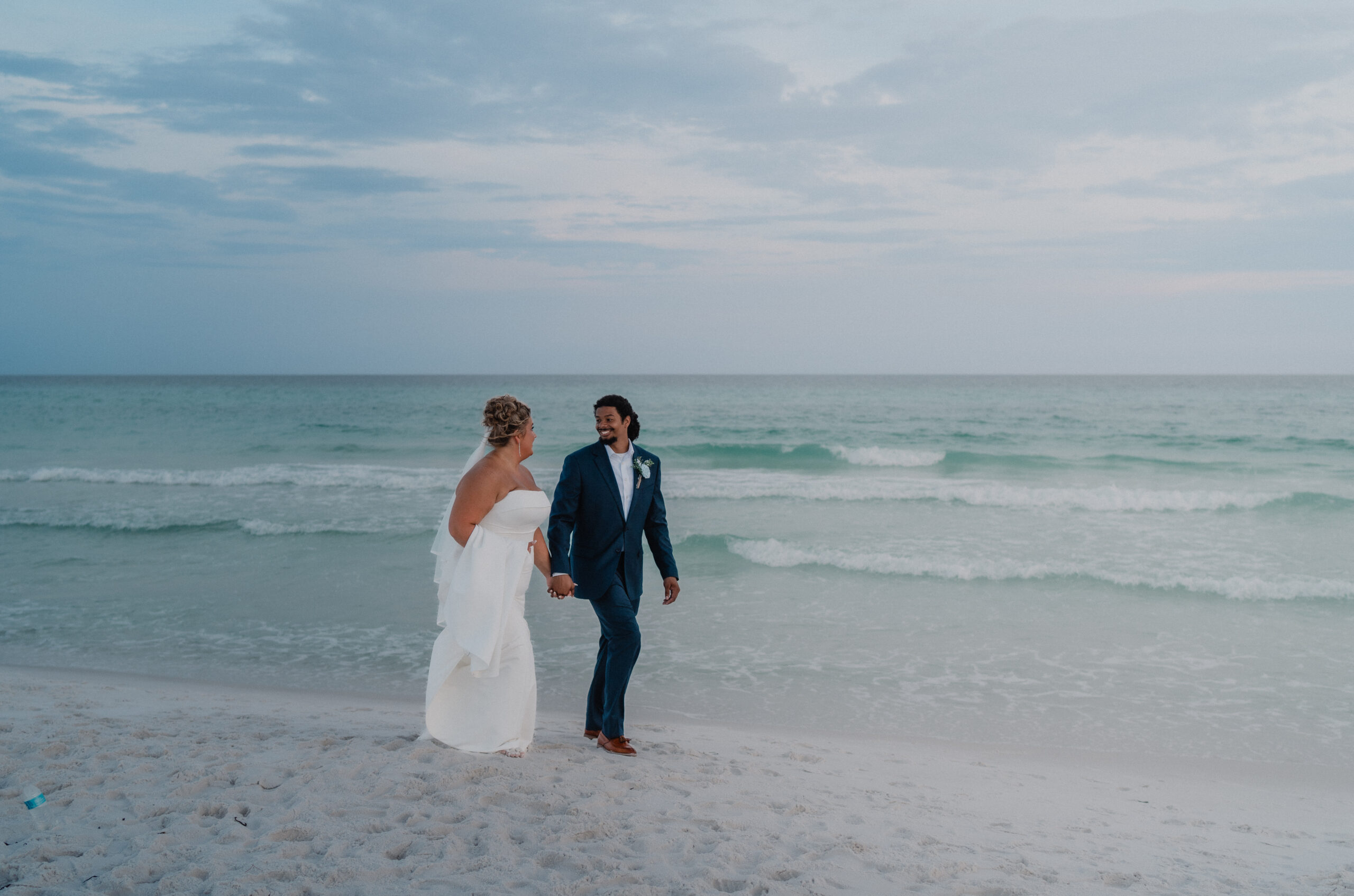
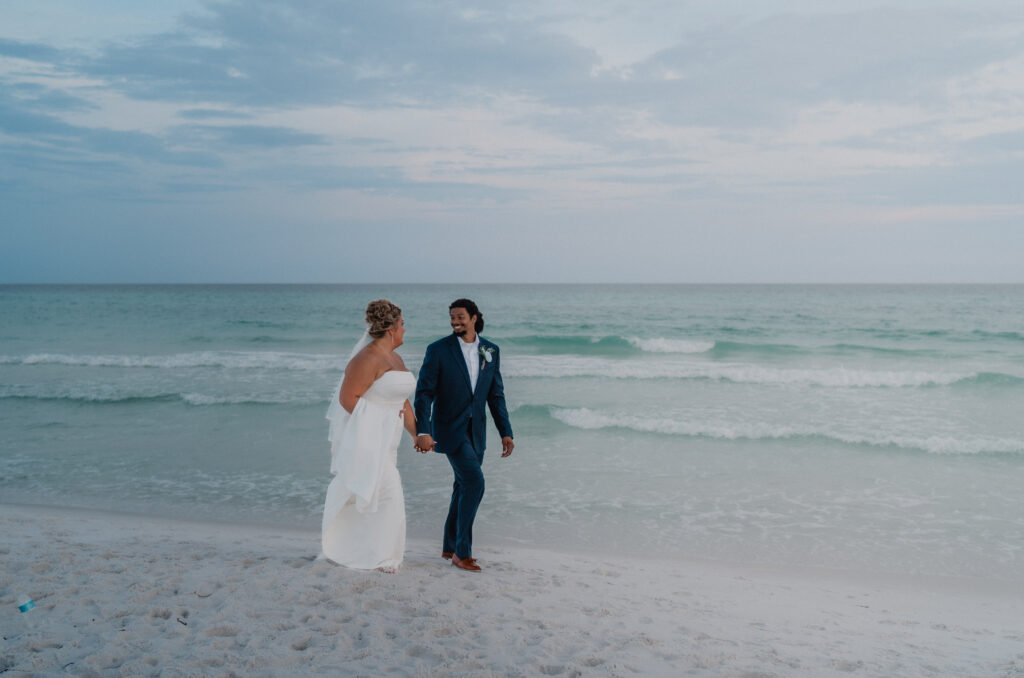
There’s a version of this question that’s easy to answer: the best weather for a Gulf Coast wedding is in the spring and the fall. April, May, October, early November—warm days, comfortable evenings, and the kind of light that makes every frame look like it belongs in a magazine.
But here’s the part that the easy answer leaves out: those same months are also the hardest to book. Venues fill first. Preferred photographers, planners, and officiants get locked in months (sometimes a year) in advance. Lodging supply tightens. And in areas where public beach ceremonies are permitted, the permitting systems themselves exist specifically to prevent multiple weddings from stacking at the same access point at the same time—which tells you everything you need to know about how much demand those dates carry.
So the real question isn’t just “when is the weather best?” It’s “when does the best balance of weather, availability, and logistics come together for our specific wedding?” And the answer depends on where along the Gulf Coast you’re getting married, how many guests you’re hosting, whether you need a beach ceremony or a venue, and how far in advance you’re planning.
This guide breaks down every month of the year across four Gulf Coast destinations—Destin, 30A (South Walton), Pensacola, and Orange Beach—with climate data, sea temperatures, hurricane risk, tourist congestion, vendor availability, and the permitting realities that quietly shape what’s possible on any given weekend. We’ve filmed and photographed weddings across all four of these areas, in every season, and the patterns are consistent enough to be useful—and specific enough to actually help you choose.
The Two “Perfect” Windows (and Why They’re the Hardest to Book)
If all you’re optimizing for is outdoor comfort, two windows stand out clearly across the entire central Gulf Coast.
April through May is when the region shakes off winter. Daytime highs climb into the upper 70s and low 80s, nighttime lows settle into the comfortable upper 50s and 60s, and humidity hasn’t yet hit the oppressive levels of summer. The light is warm and clean. The Gulf is beginning to warm toward swimmable temperatures. And the landscape is green and alive. It’s easy to see why these months book up first.
October through early November is the mirror image. Summer’s heat finally breaks, daytime highs drop back into the low 80s and 70s, and humidity eases. The Gulf water is still warm from months of summer sun. The afternoon thunderstorm pattern that dominates June through September has largely subsided. And the light has that particular fall quality—lower in the sky, golden earlier in the afternoon, deeply flattering for portraits.
These windows are genuinely beautiful for weddings. But they’re also the months when every couple planning a Gulf Coast celebration has the same idea—which means venue calendars, vendor teams, and permitted beach access points are under the most pressure. If you’re set on April, May, or October, plan to book 12 to 18 months in advance and expect the tightest competition for premium dates (especially Saturdays).
The strategic alternative? Target the months just outside those peaks—where the weather is still strong, but the calendar opens up meaningfully. We’ll show you exactly which months those are, and why they work, in the tables below.
What Actually Determines the “Best” Month for Your Wedding
Weather matters, but it’s not the only variable. On the Gulf Coast, four factors intersect to determine whether a given month is realistic for the wedding you’re planning.
Climate Comfort
This is what most couples think about first: temperature, humidity, rainfall, and how the day will feel for guests standing on a beach or sitting in an outdoor ceremony. We’ll give you the full climate data below—monthly averages for high and low temperatures, rainfall, dew point ranges (which tell you more about “mugginess” than relative humidity does), daylight hours, and sea temperature—so you can evaluate comfort with actual numbers, not guesswork.
The climate normals used in this guide are drawn from the Florida Climate Center’s 1991–2020 station data for Niceville (proxying Destin-area temperatures), Panama City (proxying 30A/South Walton), and Pensacola Regional Airport (direct reference for Pensacola and the closest available proxy for Orange Beach, given its geographic proximity and shared Gulf maritime influence) (Florida Climate Center – Climate Normals). Sea temperatures come from NOAA’s Coastal Water Temperature Guide for Pensacola, Panama City Beach, and the Mobile, Alabama coastal station as a proxy for Orange Beach (NOAA – Coastal Water Temperature Guide).
For humidity, the Florida Climate Center notes that summer dew points across the Panhandle typically range from the mid-60s to low 70s°F—the range where the air feels noticeably muggy—while winter dew points are substantially lower, often in the 40s and 50s°F (Florida Climate Center – Humidity). Dew point is a better indicator of how “sticky” the day will feel than relative humidity alone, and it’s the number we reference throughout this guide.
Hurricane and Storm Risk
The Atlantic hurricane season runs June 1 through November 30 (National Hurricane Center). For Gulf Coast wedding planning, the practical impact isn’t just the storms themselves—it’s the travel disruptions (airport closures, highway congestion during evacuation orders), venue operational risk (power outages, debris, beach closures), and the stress of monitoring forecasts in the weeks leading up to your date. The Florida Climate Center documents historically notable landfalls affecting the Florida Panhandle and Alabama Gulf Coast, reinforcing that impactful storms are a real, non-theoretical risk in this region.
Risk is lowest in winter and early spring, rises through summer, and peaks in late summer through early fall (historically, August through October carries the highest activity). This doesn’t mean summer and fall weddings are a bad idea—it means your planning should include genuine weather contingency language, a real Plan B venue or indoor space, and serious consideration of event cancellation insurance.
Tourist Season and Congestion
The Gulf Coast’s tourist calendar doesn’t perfectly overlap with the wedding calendar, but it creates its own pressure. Spring break (March into April) and summer vacation (June through August) bring the highest beach traffic, the tightest lodging availability, and the most competition for public beach access. Fall sees a second, smaller bump—October often coincides with fall break travel and local festivals. Winter months (December through February) are the quietest for tourism, which translates to easier lodging blocks, less beach congestion, and smoother logistics overall.
Permits and Location Rules
This is the factor that most wedding blogs ignore entirely—and it’s one of the most important on the Gulf Coast. Where you can legally hold a ceremony, and what rules govern that location, vary dramatically by jurisdiction. These rules don’t change by season, but they create year-round constraints that compress demand into fewer compliant venues and permitted sites, which amplifies the availability pressure during peak months.
We’ll cover the permit landscape for each destination below, but here’s the headline version:
Destin: The City of Destin’s published guidance states that no special events, including weddings, are permitted on City of Destin public beaches. The fact sheet also emphasizes sea turtle protections, recommending red-light flashlights and staying away from marked nests (City of Destin – Beach Weddings Fact Sheet). If “Destin beach wedding” is your vision, you’ll plan around private beachfront property (resorts, HOAs, rental homes with beach access), alternative permitted parks, or neighboring jurisdictions. This is a critical planning detail that narrows where ceremonies can happen and concentrates demand into fewer available properties.
30A / South Walton: Walton County requires a special event permit for weddings on public beach access points, explicitly to prevent multiple ceremonies from occurring at the same location at the same time (Walton County – Code Compliance FAQ). The county publishes permitting information and fee tiers through its outdoor event and beach vendor/special event pages (Walton County – Outdoor Event Permits). Public-access beach ceremonies are viable on 30A, but prime Saturdays can bottleneck due to high wedding demand combined with administrative controls designed to prevent overlap.
Pensacola Beach: The Visit Pensacola beach wedding guidance notes that on Pensacola Beach, you may pick a spot and notify the Santa Rosa Island Authority of your location, date, time, and headcount—no permit is required for a standard ceremony (Visit Pensacola – Beach Wedding Information). However, there are clear operational rules: you may not reserve or rope off public beach areas, setups must maintain distance from beach access points and dune systems, open flames are prohibited, and tents exceeding certain sizes may require a separate permit. This framework is comparatively flexible for small-to-midsize ceremonies, which can meaningfully improve date feasibility when other destinations funnel you into private venue calendars.
Orange Beach: The city’s FAQ indicates that weddings at public beach access points require contacting Gulf State Park for a permit (City of Orange Beach – Beach Wedding FAQ). The broader Gulf Shores and Orange Beach tourism guidance similarly directs couples to Gulf State Park for permitting (Gulf Shores & Orange Beach Tourism – Weddings). Meanwhile, the City of Gulf Shores (adjacent and often part of the same destination planning) states that weddings are not allowed on Gulf Shores public beaches—typical ceremony setups like chairs, arches, and gazebos are prohibited on public sand, and couples are directed to private property or Gulf State Park options (City of Gulf Shores – Beach Weddings). In practice, “Orange Beach wedding” planning often means working with Gulf State Park–managed areas or private beachfront venues, and availability concentrates accordingly.
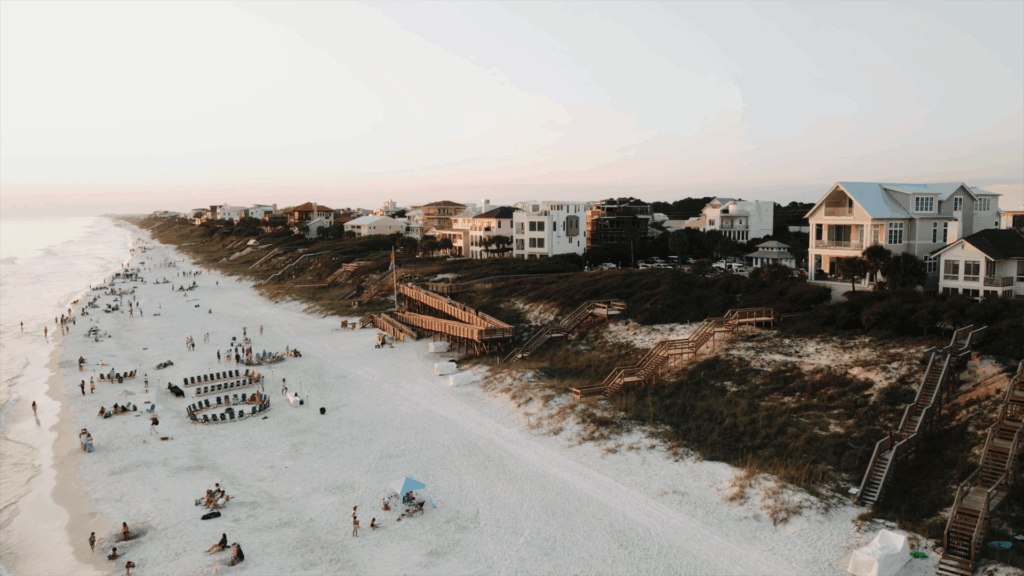
The Seasonal Pattern at a Glance
Before we get into the month-by-month data, here’s the broad seasonal picture. Understanding this pattern helps you quickly identify your target window, then use the detailed tables to refine your decision.
Late February through March offers improving weather with meaningfully better vendor availability than the April–May peak. Temperatures are cooler—highs in the mid-60s to low 70s, with nights that can dip into the 40s and 50s—but outdoor ceremonies are comfortable, humidity is low, and the light is beautiful. Daylight is increasing rapidly. Tourist congestion picks up in March due to spring break, but wedding-specific demand is lighter than what follows in April. This is the “near-peak” window that experienced Gulf Coast planners often recommend for couples who want great conditions without the booking pressure.
April through May is the classic sweet spot for weather. Highs in the upper 70s to mid-80s, comfortable evenings, lower humidity than summer, and long days. But availability is at its tightest—venues, photographers, and planners book earliest for these months. Plan to book 12–18 months out.
June through August is summer: hot (highs around 89–92°F), humid (dew points in the mid-60s to low 70s), and punctuated by afternoon thunderstorms. Tourist traffic is at its peak. The upside is late sunsets—nearly 8:00 PM in June and July—giving you the longest portrait windows and the most timeline flexibility. Many couples love summer Gulf Coast weddings, but the heat requires infrastructure planning (shade, hydration, fans, earlier ceremony timing) and the thunderstorm pattern demands a genuine Plan B.
September is transitional. Still warm, still within hurricane season, but tourist traffic begins to ease. It’s often underappreciated as a wedding month—temperatures are beginning to moderate, and vendor calendars are less compressed than October.
October through early November is the second classic peak. Beautiful weather (highs in the low 80s dropping into the 70s, lower humidity, comfortable evenings), warm Gulf water, and stunning light. But like April–May, these months are heavily demanded. October is often the single tightest month for vendor availability on the Gulf Coast.
Mid-to-late November and early December offer a second “near-peak” opportunity. Temperatures are cooler (highs in the low 70s, lows in the 40s and 50s), days are shorter, and you’ll need earlier ceremony timing to catch the light. But availability opens up considerably, hurricane season has ended or is ending, and the Gulf Coast has a calm, intimate quality in early winter that photographs beautifully. Avoid Thanksgiving week and the holiday travel weeks around Christmas, and you have a window with genuinely easy logistics.
December through February is the quiet season. Coolest temperatures, shortest days, lowest tourist traffic, and the widest-open vendor calendars. A winter Gulf Coast wedding is a different aesthetic—layered attire, warm ceremony lighting, earlier golden hour—but for couples who are flexible on the “look,” the planning ease is unmatched.
Destin: Month-by-Month Planning Table
Important note: City of Destin public beaches do not permit weddings or special events. Plan around compliant private venues or other jurisdictions first, then choose your month. This restriction concentrates ceremony demand into a smaller pool of available properties, which tightens availability even further during peak months.
Best month clusters for Destin (availability-first, still weather-respectful): Late February through March offers good comfort, increasing daylight, and typically less booking compression than the April–May peak. Mid-to-late November and early December are cooler but workable for outdoor ceremonies with layered attire and earlier sunset timing—and vendor calendars are significantly more open.
| Month | Avg High (°F) | Avg Low (°F) | Avg Rainfall (in) | Dew Point Range (°F) | Daylight (hrs) | Sea Temp (°F) | Hurricane Risk | Tourist Level | Vendor Availability |
|---|---|---|---|---|---|---|---|---|---|
| January | 61 | 38 | 5.0 | 40–50 | 10.2 | 57 | Low | Low | High |
| February | 65 | 41 | 4.8 | 40–50 | 10.9 | 59 | Low | Low | High |
| March | 70 | 46 | 5.2 | 45–55 | 11.8 | 65 | Low | High | Medium |
| April | 76 | 53 | 5.5 | 50–60 | 12.7 | 72 | Low | High | Low |
| May | 84 | 61 | 3.9 | 55–65 | 13.5 | 79 | Low | High | Low |
| June | 88 | 69 | 7.3 | 65–75 | 13.9 | 84 | Medium | High | Medium |
| July | 90 | 72 | 7.9 | 65–75 | 13.8 | 86 | Medium | High | Medium |
| August | 90 | 72 | 7.5 | 65–75 | 13.1 | 87 | High | High | Medium |
| September | 87 | 68 | 6.6 | 65–75 | 12.2 | 83 | High | Medium | Medium |
| October | 80 | 57 | 4.7 | 55–65 | 11.2 | 76 | Medium | Medium | Low |
| November | 71 | 45 | 4.4 | 45–55 | 10.4 | 67 | Low | Medium | Medium |
| December | 64 | 41 | 5.4 | 40–50 | 10.1 | 60 | Low | Medium | High |
Reading the availability column: “High” means vendor teams and venue dates are typically most available—especially if you’re open to non-Saturday dates. “Medium” means competition exists but strong options remain. “Low” means prime venues and top vendors are booked far in advance, and permitting bottlenecks are more likely in public-access models. These ratings account for Destin’s public beach restrictions, which concentrate demand into fewer compliant properties.
30A / South Walton: Month-by-Month Planning Table
Permitting context: Walton County requires special event permits for weddings on public beach access points, designed to prevent simultaneous conflicts at the same location. Build your date selection around permit availability early in the planning process—prime Saturday permits for peak months can be claimed well in advance.
Best month clusters for 30A (availability-first): Late February through March offers strong aesthetics and better scheduling flexibility than the April–May peak. Mid-to-late November provides cooler temperatures, fewer scheduling collisions, and generally easier lodging coordination outside holiday weeks.
| Month | Avg High (°F) | Avg Low (°F) | Avg Rainfall (in) | Dew Point Range (°F) | Daylight (hrs) | Sea Temp (°F) | Hurricane Risk | Tourist Level | Vendor Availability |
|---|---|---|---|---|---|---|---|---|---|
| January | 64 | 43 | 4.8 | 40–50 | 10.2 | 60 | Low | Low | High |
| February | 67 | 46 | 5.0 | 40–50 | 10.9 | 60 | Low | Low | High |
| March | 73 | 52 | 5.0 | 45–55 | 11.8 | 65 | Low | High | Medium |
| April | 79 | 58 | 4.1 | 50–60 | 12.7 | 70 | Low | High | Low |
| May | 85 | 66 | 3.3 | 55–65 | 13.5 | 77 | Low | High | Low |
| June | 89 | 73 | 5.8 | 65–75 | 13.9 | 82 | Medium | High | Medium |
| July | 91 | 75 | 7.4 | 65–75 | 13.8 | 84 | Medium | High | Medium |
| August | 91 | 75 | 7.4 | 65–75 | 13.1 | 86 | High | High | Medium |
| September | 89 | 71 | 7.0 | 65–75 | 12.2 | 84 | High | Medium | Medium |
| October | 82 | 61 | 3.5 | 55–65 | 11.2 | 78 | Medium | Medium | Low |
| November | 73 | 50 | 3.7 | 45–55 | 10.4 | 70 | Low | Medium | Medium |
| December | 67 | 45 | 4.3 | 40–50 | 10.1 | 63 | Low | Medium | High |
Pensacola: Month-by-Month Planning Table
Permitting context: Pensacola Beach offers comparatively flexible public-wedding rules for smaller events. The standard approach is to notify the Santa Rosa Island Authority of your ceremony location, date, time, and headcount—no formal permit is required for a typical ceremony. Operational constraints apply (no roping off public space, distance from access points and dunes, no open flames, tent size limits), but this framework can meaningfully improve date feasibility compared to destinations that funnel all ceremonies into private venue calendars.
Best month clusters for Pensacola (availability-first): February through March offers cooler but workable conditions with less calendar compression than the April–May peak and improving daylight. Mid-to-late November provides fewer scheduling conflicts and generally easier logistics, assuming you avoid holiday-week peaks.
| Month | Avg High (°F) | Avg Low (°F) | Avg Rainfall (in) | Dew Point Range (°F) | Daylight (hrs) | Sea Temp (°F) | Hurricane Risk | Tourist Level | Vendor Availability |
|---|---|---|---|---|---|---|---|---|---|
| January | 63 | 44 | 5.0 | 40–50 | 10.2 | 57 | Low | Low | High |
| February | 66 | 47 | 4.8 | 40–50 | 10.9 | 59 | Low | Low | High |
| March | 72 | 53 | 5.2 | 45–55 | 11.8 | 65 | Low | High | Medium |
| April | 78 | 59 | 5.5 | 50–60 | 12.7 | 72 | Low | High | Low |
| May | 85 | 67 | 3.9 | 55–65 | 13.5 | 79 | Low | High | Low |
| June | 90 | 74 | 7.3 | 65–75 | 13.9 | 84 | Medium | High | Medium |
| July | 92 | 75 | 7.9 | 65–75 | 13.8 | 86 | Medium | High | Medium |
| August | 91 | 75 | 7.5 | 65–75 | 13.1 | 87 | High | High | Medium |
| September | 89 | 72 | 6.6 | 65–75 | 12.2 | 83 | High | Medium | Medium |
| October | 81 | 62 | 4.7 | 55–65 | 11.2 | 76 | Medium | Medium | Low |
| November | 72 | 51 | 4.4 | 45–55 | 10.4 | 67 | Low | Medium | Medium |
| December | 65 | 46 | 5.4 | 40–50 | 10.1 | 60 | Low | Medium | High |
Orange Beach: Month-by-Month Planning Table
Permitting context: Public beach access weddings in Orange Beach require Gulf State Park coordination and permitting per city guidance. The adjacent City of Gulf Shores does not allow weddings on its public beaches—typical ceremony setups (chairs, arches, gazebos) are prohibited on public sand, and couples are directed to private property or Gulf State Park options. In practice, “Orange Beach wedding” planning often means working with Gulf State Park–managed areas or private beachfront venues, and ceremony availability concentrates accordingly.
Best month clusters for Orange Beach (availability-first): Late February through March offers the best balance of comfort and planning flexibility. Mid-to-late November and early December provide calmer demand and easier vendor scheduling. The Gulf Shores International Airport at Jack Edwards Field now offers commercial service, which can reduce guest travel friction for certain markets—though schedules are more limited than major hub airports.
| Month | Avg High (°F) | Avg Low (°F) | Avg Rainfall (in) | Dew Point Range (°F) | Daylight (hrs) | Sea Temp (°F) | Hurricane Risk | Tourist Level | Vendor Availability |
|---|---|---|---|---|---|---|---|---|---|
| January | 63 | 44 | 5.0 | 40–50 | 10.2 | 56 | Low | Low | High |
| February | 66 | 47 | 4.8 | 40–50 | 10.9 | 58 | Low | Low | High |
| March | 72 | 53 | 5.2 | 45–55 | 11.8 | 64 | Low | High | Medium |
| April | 78 | 59 | 5.5 | 50–60 | 12.7 | 71 | Low | High | Low |
| May | 85 | 67 | 3.9 | 55–65 | 13.5 | 78 | Low | High | Low |
| June | 90 | 74 | 7.3 | 65–75 | 13.9 | 84 | Medium | High | Medium |
| July | 92 | 75 | 7.9 | 65–75 | 13.8 | 86 | Medium | High | Medium |
| August | 91 | 75 | 7.5 | 65–75 | 13.1 | 86 | High | High | Medium |
| September | 89 | 72 | 6.6 | 65–75 | 12.2 | 84 | High | Medium | Medium |
| October | 81 | 62 | 4.7 | 55–65 | 11.2 | 77 | Medium | Medium | Low |
| November | 72 | 51 | 4.4 | 45–55 | 10.4 | 67 | Low | Medium | Medium |
| December | 65 | 46 | 5.4 | 40–50 | 10.1 | 60 | Low | Medium | High |
[Image suggestion: Bride and groom walking along the Gulf at golden hour with warm amber light, captured by White Sands Weddings — showing the quality of light that every season on the Gulf Coast can deliver with the right timing.]
What Each Season Feels Like (and What It Means for Your Photos and Film)
The data tells you the numbers. Here’s what the numbers feel like when you’re standing in a ceremony, walking through portraits, or dancing at a reception on the Gulf Coast.
Winter (December through February)
The air is crisp. Highs in the low-to-mid 60s mean a light jacket feels right, and evenings in the 40s call for wraps, shawls, or layers—which, for what it’s worth, photograph beautifully. The Gulf water is cool (upper 50s to low 60s), so “barefoot on the beach” is more of a portrait moment than a prolonged experience. Humidity is low, which is a blessing for hair and makeup and for guest comfort alike.
The biggest planning consideration is daylight. Sunset arrives before 5:15 PM from November through February, which means your ceremony may need to start by 3:00 or 3:30 PM to catch golden-hour light. That compresses the day and pushes hair and makeup earlier in the morning—but it also means a shorter gap between the ceremony and the reception, which keeps the momentum of the day flowing naturally.
For your gallery and film, winter light on the Gulf Coast has a quality that summer can’t replicate—low in the sky, golden, and deeply warm even when the air temperature isn’t. Some of the most dramatic portraits we’ve ever captured were during winter golden hours, when the sun hangs at an angle that wraps around the couple and turns the sand and water into something almost painterly.
Spring (March through May)
This is the season most couples picture when they imagine a Gulf Coast wedding. By April, daytime highs are in the upper 70s, evenings are mild, the Gulf is warming toward comfortable swimming temperatures, and the humidity hasn’t yet reached summer levels. Daylight extends past 7:00 PM by April, giving you generous timeline flexibility and long, beautiful golden hours.
March is slightly cooler—highs in the low 70s—but it’s the month that experienced planners often recommend as the best-kept scheduling opportunity of the year. The weather is comfortable, the light is excellent, and the vendor calendar hasn’t yet reached the compression of April and May. Tourist traffic does pick up in March due to spring break, but wedding-specific demand is lighter.
The tradeoff in April and May is straightforward: the weather is ideal, but so is the demand. If these months are non-negotiable for you, book early, be flexible on the day of the week (Fridays and Sundays carry less competition than Saturdays), and lock in your “constraint vendors”—photographer, planner, and ceremony site—first, because those are the bottlenecks.
Summer (June through August)
Summer on the Gulf Coast is hot, humid, and alive. Daytime highs push into the upper 80s and low 90s, dew points sit in the mid-60s to low 70s (the range where the air feels heavy), and afternoon thunderstorms are a near-daily pattern. The National Weather Service notes that heat index values are calculated for shade and light wind conditions, and full sunshine can add up to 15 degrees to the perceived temperature—which is directly relevant to an exposed beach ceremony at 4:00 PM.
But summer also brings the latest sunsets of the year—nearly 8:00 PM in June and July—which means the longest golden hours, the most timeline flexibility, and the ability to schedule a later ceremony that avoids the worst of the afternoon heat. Many of our couples choose summer specifically for this reason: the late light is extraordinary, and if the ceremony starts after 6:00 PM, the temperature has often moderated enough to be comfortable.
The production considerations are real: shade and hydration for guests, wind-safe décor, a genuine lightning and rain contingency plan, and hair and makeup scheduling that accounts for humidity. But a well-planned summer Gulf Coast wedding—with the right timing and the right team—is one of the most cinematic events we photograph all year.
Fall (September through November)
September is the shoulder month. It’s still warm (highs in the upper 80s), still within the heart of hurricane season, and still humid—but tourist traffic begins to ease, and the feel of the coastline starts to shift. It’s an underappreciated month for couples who want summer-like conditions with slightly less booking pressure.
October is the crown jewel of the fall season, and it shows in the availability data. Highs in the low 80s, comfortable evenings, warm Gulf water, lower humidity, and the kind of golden light that makes photographers and filmmakers genuinely excited. But October is also the single tightest month for Gulf Coast wedding vendors, competing with April and May for the “hardest to book” title. If October is your month, treat it like April: book early, be flexible, and secure your team well in advance.
Early November carries much of October’s weather appeal (highs in the low 70s, low humidity, beautiful light) with meaningfully better availability. By mid-to-late November, vendor calendars open further, though the window narrows as you approach Thanksgiving. Sunset arrives earlier—around 4:50 PM—which requires earlier ceremony timing, but the day has a peaceful, intimate quality that works beautifully for couples who aren’t chasing the big, sprawling summer celebration.
How to Choose Your Month: A Framework
Rather than just giving you one recommendation, here’s the decision logic we use with our own couples.
Start with jurisdiction feasibility. If you want a true beachfront ceremony, verify first whether your chosen location allows it. Destin’s public beaches do not permit weddings. Walton County requires a special event permit. Pensacola Beach requires SRIA notification but not a formal permit for standard ceremonies. Orange Beach routes through Gulf State Park. Know the rules before you pick the date, because the rules determine where your ceremony can happen—and that determines which venue or site calendars you’re working with.
Lock the constraint vendors first. In every month—but especially during peak season—photographers, planners, rental companies, and popular ceremony sites are the first bottlenecks. Even when a venue has your date available, your preferred photo and video team may not. In the Gulf Coast wedding market, these vendors have hard capacity limits per weekend, and once they’re booked, they’re booked.
Treat Saturday sunset as the scarcest resource. If your schedule allows, shifting to a Friday evening or Sunday late afternoon often improves availability dramatically while preserving the weather advantages of your chosen month. This is especially true in April, May, and October, where Saturday availability can be spoken for a year or more in advance.
Match ceremony timing to heat, humidity, and location rules. A summer ceremony at 3:00 PM on an exposed beach is a fundamentally different guest experience than a 6:00 PM ceremony at the same location. Pensacola Beach guidelines, for example, constrain how space can be staged and emphasize keeping clear of access points and dunes—which affects not just layout but timing (how early you can realistically set up). The rules of your specific location shape the logistics, and the logistics shape the timeline.
If the peak months are your priority, plan for the competition. April, May, and October are worth the effort if you’re willing to book 12–18 months ahead, secure vendors early, and accept that premium Saturday dates carry the tightest competition. The weather during those windows is genuinely the best the Gulf Coast offers, and the photos and film from those months reflect it.
If flexibility is your priority, target the near-peak windows. Late February through March and mid-to-late November are the months we most often recommend to couples who want strong weather, beautiful light, and a planning process that doesn’t feel like a race. The conditions are excellent, the vendor calendars are measurably more open, and the resulting weddings are some of the most relaxed, joyful celebrations we capture all year.
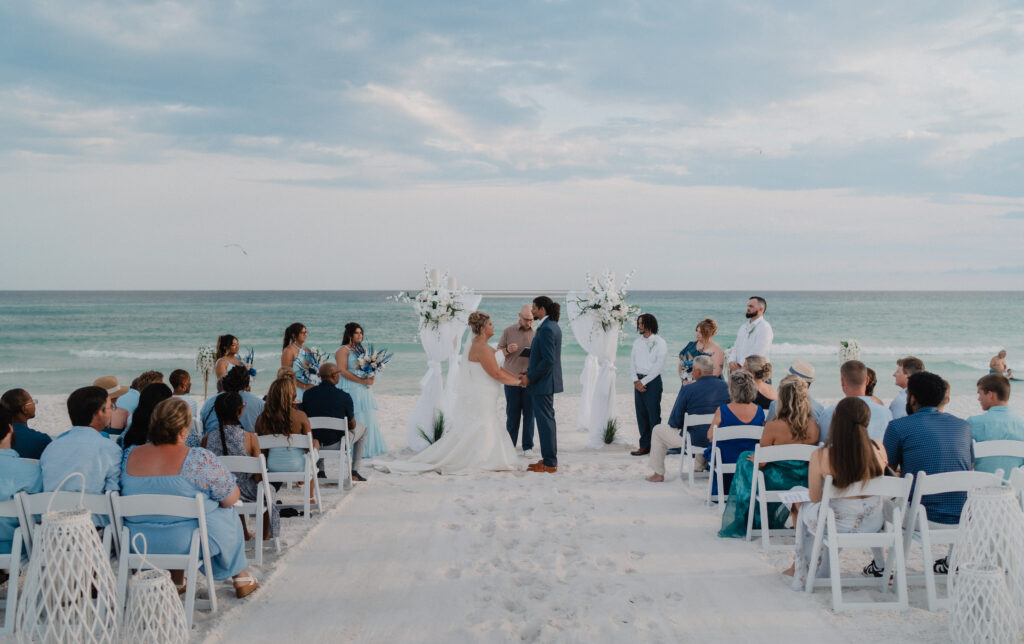
Frequently Asked Questions
What is the best month for a Gulf Coast beach wedding?
For weather alone, April, May, and October are the strongest months—comfortable temperatures, moderate humidity, and beautiful light. For the best balance of weather and availability, March and early November are the strategic picks. For the widest-open vendor calendars with still-comfortable conditions, late February or early December offer genuine planning advantages.
What months have the latest sunsets on the Gulf Coast?
June and July, when sunset falls around 7:48–7:53 PM depending on your exact location. This gives you the latest possible ceremony start times and the longest golden-hour portrait windows. For comparison, December sunsets arrive around 4:47–4:51 PM—a three-hour swing that fundamentally changes your timeline structure. For exact sunset times on your wedding date, use the NOAA Sunrise/Sunset Calculator or timeanddate.com.
When is hurricane season on the Gulf Coast?
June 1 through November 30, per the National Hurricane Center. Peak activity historically concentrates in August through October. This doesn’t mean you should avoid these months—the vast majority of wedding weekends go as planned. It does mean your contracts should include weather contingency clauses, your venue should have an indoor Plan B, and you should evaluate event cancellation insurance early in your planning.
Is it too hot for an outdoor wedding in summer on the Gulf Coast?
It depends on your timing and planning. Daytime highs in June through August run 88–92°F, and the heat index in direct sun can be significantly higher. A 3:00 PM beach ceremony in July will be hot. A 6:30 PM ceremony with shade structures and hydration stations is a different experience entirely. If summer is your month, plan the ceremony for late afternoon or early evening, invest in guest comfort (shade, fans, water), and use the late sunset to your advantage—it’s the reason summer galleries have some of the most dramatic light of the year.
Do I need a permit for a beach wedding in Destin?
City of Destin public beaches do not allow special events, including weddings. If you want a beach ceremony near Destin, you’ll work with private beachfront venues, resorts, or properties in neighboring jurisdictions (like Walton County or Okaloosa County) that have their own permitting processes. This is one of the most important planning details for Destin-area couples, and it should be confirmed very early in the process.
Do I need a permit for a beach wedding on 30A?
Yes. Walton County requires a special event permit for weddings on public beach access points. The permit system is designed to prevent multiple ceremonies from conflicting at the same location. Apply early, especially for peak-season Saturday dates.
Can I have a beach wedding on Pensacola Beach without a permit?
For a standard ceremony, you notify the Santa Rosa Island Authority (you don’t need a formal permit), but you must follow their operational rules—no roping off public space, distance from access points and dunes, no open flames, and tent size limits. Larger events or those requiring tents above a certain size may need a permit. Read the current SRIA guidelines directly.
Is the Gulf warm enough to swim in during a winter wedding?
Not really. Winter sea temperatures along this stretch of coast range from the upper 50s to low 60s°F—cool enough that “guests playing in the surf” isn’t realistic for a December or January wedding. By April, water temperatures climb into the low 70s, and by June they’re in the low 80s. If beach swimming is part of the guest experience you’re planning, aim for May through October.
Your Season, Your Story
Every month on the Gulf Coast has something to offer a wedding. The spring and fall peaks deliver ideal temperatures and gorgeous light—but they demand early planning and competitive booking. Summer brings drama, late sunsets, and long golden hours—but it asks you to plan for heat and weather. Winter offers calm, intimacy, and wide-open calendars—but it requires earlier timing and layered warmth.
The “best” month is the one that aligns your weather tolerance, your guest experience vision, your booking timeline, and the logistical realities of where you want to say your vows. There’s a right answer for every couple—it just isn’t the same answer for all of them.
At White Sands Weddings, we’ve photographed and filmed celebrations in every one of these months, across every one of these destinations. We know what January light looks like on the dunes in Destin. We know how a June thunderstorm clears into the most cinematic sky of the year over 30A. We know how an October sunset on Pensacola Beach makes a couple glow like the whole coast was designed for them. And we’d love to help you find the month—and the plan—that makes your day feel exactly the way you want it to.
Ready to start planning? Check your date and let’s talk about what your Gulf Coast wedding could look like.
Want more planning tools? See our guides to building a Gulf Coast wedding-day timeline, choosing between a beach wedding and a venue wedding, and the real cost of a Gulf Coast wedding in 2026 for the full planning picture.
Matthew Oakes
Founder & Filmmaker, White Sands Weddings
info@whitesandsweddings.com
Sources and Further Reading
- Florida Climate Center – Niceville 1991–2020 Normals — Destin-area temperature and rainfall baselines
- Florida Climate Center – Panama City 1991–2020 Normals — 30A / South Walton temperature and rainfall baselines
- Florida Climate Center – Pensacola 1991–2020 Normals — Pensacola and Orange Beach (proxy) temperature and rainfall baselines
- Florida Climate Center – Humidity Explainer — dew point ranges and seasonal humidity patterns
- NOAA – Coastal Water Temperature Guide — monthly sea temperatures for Pensacola, Panama City Beach, and Mobile-area stations
- National Hurricane Center – Hurricane Season — official Atlantic hurricane season dates (June 1 – November 30)
- City of Destin – Beach Weddings Fact Sheet — public beach event restrictions and sea turtle protections
- Walton County – Outdoor Event Permits — 30A / South Walton beach wedding permit information and fee tiers
- Walton County – Code Compliance FAQ — permit requirement for public beach access ceremonies
- Visit Pensacola – Beach Wedding Information — Pensacola Beach ceremony guidance and SRIA notification process
- City of Orange Beach – Beach Wedding FAQ — Gulf State Park permit coordination
- City of Gulf Shores – Beach Weddings — public beach wedding restrictions and alternatives
- Gulf Shores & Orange Beach Tourism – Weddings — destination wedding planning and permit guidance
- NOAA Sunrise/Sunset Calculator — exact sunset times for your wedding date
- timeanddate.com – Destin Sunrise/Sunset — month-by-month sunset baselines
- Gulf Shores International Airport – Jack Edwards Field — commercial air service near Orange Beach


