


Couples planning a wedding on the Gulf Coast usually ask the same question in a dozen different ways: “What is this really going to cost?” Not the Pinterest version, not the best-case scenario—real numbers, real logistics, and a budget that doesn’t unravel the moment you add a tent, a shuttle, or a second photographer.
Here’s the honest answer: in 2026, there is a national “average,” and it’s a useful starting point—but only if you understand what’s inside it and what the Gulf Coast adds to it. The most recent data from The Knot’s 2026 Real Weddings Study puts the average U.S. wedding at $34,200, based on more than 10,000 couples married in 2025 (The Knot – Average Wedding Cost). A second widely cited benchmark from Zola puts the 2026 figure at roughly $36,000 (Zola – Average Cost of a Wedding in 2026). Neither number is wrong—they’re just measuring slightly different populations with slightly different methodologies.
But here’s the part that matters for you: along the stretch from Destin and 30A to Orange Beach, your environment isn’t just a backdrop. It’s a planning variable that can change your rental list, your timeline, your vendor staffing, and your bottom line. Wind-rated tents, shuttle logistics, beach permits, sound reinforcement for outdoor vows, humidity-resilient hair and makeup, rain contingency spaces—these are the line items that don’t appear in a national average but show up on every Gulf Coast wedding budget that’s built honestly.
In this guide, we’re going to break a Gulf Coast wedding budget down line by line, show you what typically costs the most and why, and give you a planning framework that makes room for real life—including hurricane season, sea-breeze wind, and sunsets that swing from 4:47 PM in December to nearly 8:00 PM in summer. If you can plan around those realities, you can plan a wedding that feels like a dream without a budget that feels like a nightmare.
What Does a Gulf Coast Wedding Actually Cost in 2026?
The National Baseline (and What It Means)
The most data-backed benchmark available right now comes from The Knot’s 2026 Real Weddings Study: an average wedding cost of $34,200, with an average cost per guest of $292 and an average guest count of 117. That per-guest number is important, because it reinforces what every wedding planner already knows—guest count is the single most dominant cost multiplier in any wedding budget. Double the guests, and you’re not just doubling the catering bill. You’re scaling up the venue, the rentals, the staffing, the bar, the transportation, and often the timeline.
The Knot is transparent about a limitation worth noting: averages can feel misleading because weddings have no natural spending cap. Couples in lower-budget ranges spend far less than $34,200, while high-budget celebrations pull the average upward. A $15,000 wedding and a $150,000 wedding both factor into the same number. So use the average as a compass, not a prescription—a sense of where the market sits nationally, not a target you’re obligated to hit.
Zola’s 2026 guide offers a slightly different figure—roughly $36,000—and emphasizes that costs vary widely by location and priorities. In your planning, treat these as two data points that tell the same story: a typical U.S. wedding in 2026 clusters in the low-to-mid five figures, but the variance is enormous, and your specific number will depend on your guest count, your geography, and the experience you’re designing.
What “Luxury” Changes
When couples move from a “standard” wedding into luxury territory—whether that means a larger guest count, a more curated vendor team, multi-event weekends, or simply a higher standard of design and production—the cost doesn’t just scale linearly. It shifts structurally. The percentage of your budget going to production and design (lighting, staging, florals, staffing) increases relative to the basics. Your photo and video team may need to be larger, work longer, and deliver a wider range of final products. Your planner goes from “coordinator” to “producer.” And on the Gulf Coast specifically, the gap between a standard outdoor wedding and a luxury one often comes down to infrastructure: better tenting, better sound, better contingency planning, and more hands to execute it all seamlessly.
The national average is a starting line. What you build from there depends on what “your wedding” actually looks like.
The Budget Breakdown That Actually Works
Data-Backed Baseline Percentages
Before you assign dollars to categories, it helps to understand where wedding budgets typically go. The Knot’s data provides a widely referenced percentage breakdown based on real couples’ spending patterns (The Knot – Wedding Budget Breakdown):
| Category | Typical % of Budget |
|---|---|
| Venue + Rentals | ~29% |
| Catering, Cake + Drinks | ~24% |
| Photography + Videography | ~10% |
| Floral + Décor | ~9% |
| Music / Entertainment | ~6% |
| Attire + Beauty | ~6% |
| Rings | ~5% |
| Planner / Coordinator | ~5% |
| Guest Entertainment | ~3% |
| Transportation | ~2% |
| Stationery | ~1% |
| Officiant | ~1% |
Two things stand out immediately. First, venue and catering alone typically consume more than half of the total budget—roughly 53% combined. This is the reason guest count matters so much: it’s not just another variable; it’s the variable that moves the two largest line items simultaneously. Second, photography and videography sit at approximately 10%, which on a $34,200 budget translates to roughly $3,400. Whether that number feels right for your wedding depends entirely on what you value, what you need captured, and how complex your day is—topics we’ll dig into below.
It’s worth noting that alternative budget models exist. Brides publishes a different allocation framework—for example, placing venue and catering at 35% and planning at 12%—which illustrates that “typical” breakdowns vary by methodology and wedding style (Brides – Wedding Budget Allocation). The percentages above are a starting framework, not gospel. Your budget should reflect your priorities, not someone else’s averages.
Where Gulf Coast Weddings Commonly Need Extra Buffer
Here’s where the Gulf Coast diverges from the national baseline. Even when couples start with standard percentage allocations, the environment tends to push certain categories higher.
Rentals and lighting expand when you’re outdoors. A beach ceremony often requires wind-rated chairs, a weighted arch with engineered floral mechanics, aisle runners designed for sand, portable sound equipment, and additional labor for load-in over soft terrain. An outdoor reception—or even a tented one—adds flooring, climate control (fans, misters), generator or power distribution, and lighting designed to work after sunset in an open-air environment. These aren’t luxury upgrades. On the Gulf Coast, they’re operational necessities.
Transportation becomes a line item, not an afterthought. Many beachfront areas have limited parking. If your venue is on 30A, your hotel block is in Destin, and your ceremony is at a beach access point three miles from either—shuttles aren’t optional. They’re the only way your guests arrive on time, park safely, and get home without navigating unfamiliar roads in the dark. This is often one of the first “surprise” costs couples feel when the Gulf Coast budget starts taking shape.
Planner coordination time scales with complexity. A Gulf Coast wedding planner isn’t just managing the vendor team. They’re managing permits, rain plans, vendor load-in over sand, shuttle timing, wind contingencies, and the communication chain that keeps fifty people informed when a storm cell appears on radar at 3:00 PM. During hurricane season or peak summer heat, the planner’s role expands further—coordinating Plan B activation, managing overtime authorizations, and keeping the day calm when the weather isn’t. That expanded scope often pushes planner costs above the national baseline.
Line-Item Cost Drivers: What Moves the Needle the Most
This is the section where national averages meet Gulf Coast reality. We’ll walk through the major budget categories using The Knot’s 2026 data-backed averages as a starting point, then explain what shifts when you’re planning in Destin, along 30A, or in Orange Beach.
Venue + Rentals
National baseline: The Knot reports an average reception venue cost of $12,900.
On the Gulf Coast, “venue” can mean wildly different things. A private beachfront estate, a luxury resort ballroom, a county park pavilion, and a stretch of public sand all qualify as “where you’re getting married”—but they carry completely different cost structures, included services, and logistical requirements.
A resort or dedicated event venue typically packages the space with tables, chairs, catering infrastructure, a built-in Plan B for weather, and staff who manage setup and teardown. The price is higher, but the scope of what you’re buying is much larger—and the number of separate rental vendors you need shrinks dramatically.
A beach ceremony on public or permitted land shifts the cost equation. The venue fee itself may be modest (a permit fee ranging from $50 to $1,000 depending on jurisdiction and guest count), but you’re now responsible for everything that a venue would otherwise provide: chairs, an arch or altar structure, aisle treatment, sound equipment, portable restrooms, shade structures, and the labor to get all of it onto the sand and off again before the permit window closes. These “à la carte” costs add up quickly, and they’re often invisible in the initial budget because no single vendor is quoting the full picture.
Catering + Beverage
National baseline: The Knot reports an average catering cost of $80 per person, with alcohol averaging $2,800 total.
Guest count is the primary driver here, and the math is unforgiving. At $80 per person, a 100-guest wedding is $8,000 in catering alone—before alcohol, service charges, gratuity, and any upgrades to service style. Outdoor Gulf Coast receptions can add complexity: food service in heat requires different logistics (timing, shade, temperature management), and bar setups on sand or under tents require their own infrastructure.
The per-person number is the one to watch. Service style (plated vs. buffet vs. stations), menu complexity, bar package structure (open bar vs. consumption-based), and venue-specific minimums all influence the final number. Many resort venues have food-and-beverage minimums that function as a de facto venue cost on top of any site fee. Ask for this number early—it’s one of the most important figures in your planning.
Florals + Décor
National baseline: $2,800.
On the Gulf Coast, florals are not purely aesthetic—they’re structural. A ceremony arch on an open beach needs to be engineered to withstand sustained 15–20 mph winds without toppling. That means weighted bases, secure mechanics, and often heavier structural materials than an indoor installation would require. The floral designer’s labor increases, and the cost follows.
Heat tolerance is the second factor. Some flower varieties wilt quickly in Gulf Coast summer heat and humidity. Your florist will recommend hardier options or plan for later installation timing—both of which can affect cost. And if you’re repurposing ceremony florals at the reception (a smart budget move), that requires additional labor for the transition, especially if the ceremony and reception are at different locations.
Music + Entertainment
National baseline: DJ at $1,800; live band at $4,500.
For a beach ceremony, the entertainment cost intersects with the audio challenge. If amplified sound is permitted at your location (and at some public beaches it isn’t), you’ll need equipment rated for outdoor use plus a sound check that accounts for wind direction and surf noise. If amplified sound isn’t permitted, your ceremony entertainment becomes acoustic—which can be beautiful, but limits options. For your ceremony film, the DJ or musician’s feed is often one of the audio sources your videographer captures, so coordination between entertainment and film teams matters.
At the reception, the cost drivers are more standard: DJ versus live band, length of performance, equipment needs, and whether the entertainment covers ceremony music as well. Outdoor receptions on the Gulf Coast may require additional sound equipment to project across open space, and noise restrictions (which vary by venue and jurisdiction) can affect volume levels and curfew times.
Photography + Videography
National baseline: Photographer at $3,000; videographer at $2,300.
This is the category where Gulf Coast conditions most directly affect what you need—not just what you want. A beach ceremony requires audio equipment and wind protection that an indoor ceremony doesn’t. A multi-location wedding day (getting ready at a rental house, ceremony on the beach, reception at a venue) requires more coverage hours and more transit time than a single-property celebration. A sunset that shifts from 4:47 PM in December to 7:49 PM in June means your portrait window—and therefore your total coverage—is tied to the calendar in ways that indoor weddings aren’t.
Here’s how coverage hours, team size, and deliverables typically scale:
The national average of ~$3,000 for photography covers what we’d consider entry-level to mid-range professionals. For couples who prioritize their wedding imagery—who want a team experienced with Gulf Coast light, wind, and logistics, with the staffing to cover a complex day without missing moments—the investment is typically higher. For a deeper look at what different price levels deliver, see our guide to wedding photography costs in 2025 for Destin, 30A, and beyond.
Planner / Coordinator
National baseline: $2,100.
On the Gulf Coast, the planner’s role is unusually important. A planner who knows this area understands the permit landscape, the weather patterns, the venue-specific load-in quirks, the shuttle routes, and the difference between a rain plan that exists on paper and one that actually works when a storm cell shows up at 4:00 PM. If your wedding involves a beach ceremony, multiple locations, or falls during hurricane season, a planner who can manage complexity is one of the highest-value investments in your budget.
The national baseline assumes month-of coordination. Full-service planning—especially for destination couples who aren’t local to the Gulf Coast—costs more, but it also absorbs an enormous amount of the logistical work that would otherwise fall on you.
Permits and Hidden Fees
This is the line item that doesn’t appear in national breakdowns but matters enormously on the Gulf Coast. Permit requirements vary by jurisdiction, and the cost—both in fees and in the planning complexity they create—is often underestimated.
City of Destin: The city’s Beach Event Fact Sheet states that no special events are permitted on City of Destin public beaches, with specific constraints on décor, generators, structures, noise, and sea turtle protections (City of Destin – Beach Weddings Fact Sheet). This pushes couples toward private property, county parks, or other jurisdictions—often changing the rental and coordination picture significantly.
Walton County (30A / South Walton): Walton County publishes beach event permit fees on an attendance-based tier structure—for example, $150 for 1–30 guests up to $1,000 for 76+ guests (Walton County – Outdoor Event Permits). This is explicitly special-event permitting, and the calendar-based system is designed to prevent multiple weddings from stacking at the same location and time.
Okaloosa County: Okaloosa County publishes wedding and special event permit guidance with fees that vary by program and location. One county document references a $50 wedding permit fee, while other materials describe sliding-scale special event fees and additional requirements (Okaloosa County – Wedding Permits). Couples should confirm directly with the county for their chosen site.
Gulf Islands National Seashore: Federal parkland weddings require special use permits through the National Park Service. Established facilities like reservable pavilions have listed daily rates—for example, $200 for the Johnson Beach Pavilion and $300 for Opal Beach pavilions (NPS – Gulf Islands National Seashore Permits). Entrance fees may apply separately.
Beyond permit fees, “hidden” costs that frequently surprise Gulf Coast couples include venue service charges (often 20–25% on top of catering), overtime rates for vendors who run past their contracted hours, rental delivery surcharges for beach load-in, and last-minute weather-related expenses (tent side walls, indoor flip labor, extended generator rental). Zola’s planning guidance explicitly calls out service charges and overtime as common budget surprises, and the pattern holds especially true on the Gulf Coast where weather can push timelines into unplanned territory.
Seasonality That Affects Cost on the Gulf Coast
The Gulf Coast isn’t one climate year-round. The season you choose for your wedding changes your sunset time, your weather risk profile, your guest comfort logistics, and—as a result—your budget. Here’s the data.
Sunset Timing: What It Does to Your Timeline (and Your Coverage Hours)
Sunset isn’t just aesthetic. It’s scheduling math. The time the sun goes down on your wedding date determines when your ceremony should start, when golden hour falls, and how many hours of coverage you’ll need to capture everything from getting ready through the last dance.
The table below uses mid-month (15th) sunset times for 2026, compiled from timeanddate.com monthly sun tables. All times are Central Time.
| Month | Destin | 30A (Santa Rosa Beach) | Pensacola | Orange Beach |
|---|---|---|---|---|
| January | 5:07 PM | 5:06 PM | 5:10 PM | 5:12 PM |
| February | 5:34 PM | 5:33 PM | 5:37 PM | 5:38 PM |
| March | 6:54 PM | 6:53 PM | 6:57 PM | 6:58 PM |
| April | 7:13 PM | 7:12 PM | 7:16 PM | 7:17 PM |
| May | 7:33 PM | 7:32 PM | 7:36 PM | 7:37 PM |
| June | 7:49 PM | 7:48 PM | 7:52 PM | 7:53 PM |
| July | 7:49 PM | 7:48 PM | 7:52 PM | 7:53 PM |
| August | 7:27 PM | 7:26 PM | 7:30 PM | 7:31 PM |
| September | 6:51 PM | 6:50 PM | 6:54 PM | 6:55 PM |
| October | 6:14 PM | 6:13 PM | 6:17 PM | 6:19 PM |
| November | 4:49 PM | 4:48 PM | 4:51 PM | 4:53 PM |
| December | 4:47 PM | 4:46 PM | 4:49 PM | 4:51 PM |
For your exact wedding date, generate precise times using the NOAA Sunrise/Sunset Calculator.
How this affects cost: A winter wedding (November through February) has early sunsets that compress the day. Your ceremony starts earlier, which means hair and makeup starts earlier, which can require longer “getting ready” coverage from your photo and video team. The total coverage window may need to extend later into the evening to capture the full reception, even though the outdoor portions of the day wrapped early. That compression often translates to more hours booked.
A summer wedding (June through August) has the opposite dynamic. Late sunsets create a long gap between an afternoon ceremony and the most dramatic portrait light, which can drive longer total coverage, additional “cocktail hour” experiences to fill the gap, and production design (lighting, entertainment) to carry the early evening before sunset delivers the magic. Either way, the calendar affects the coverage, and coverage affects the cost.
Hurricane Season: How to Budget and Contract for Flexibility
The Atlantic hurricane season officially runs June 1 through November 30 (National Hurricane Center). This is not a reason to avoid a summer or fall Gulf Coast wedding—the overwhelming majority of wedding weekends during this window go beautifully. It is a reason to budget thoughtfully and contract carefully.
During hurricane season, your budget should account for three things: a genuine Plan B space (either built into your venue contract or rented as a contingency), reschedule flexibility in your vendor agreements, and a deposit-protection strategy that includes evaluating event cancellation or postponement insurance. The Knot explains that cancellation and postponement coverage can reimburse lost deposits and costs when circumstances beyond a couple’s control—including severe weather or venue closure—force a change of plans (The Knot – Wedding Insurance). Policy terms vary, and it’s worth reading the fine print early in your planning process rather than after contracts are signed.
Contract clauses worth discussing with your planner and vendors (this is planning guidance, not legal advice): weather contingency and reschedule protocol—what triggers Plan B, who makes the call, and by what time. Overtime terms—the hourly rate and how it’s authorized, especially since sunset-driven timelines in summer can create accidental overtime. Force majeure language—what happens if the venue closes or access is restricted due to a coastal storm. And permit responsibility—who applies, who pays, and what happens if a permit is denied or a location becomes unavailable.
Heat, Humidity, and Guest Comfort as a Budget Line Item
Gulf Coast heat isn’t abstract. The National Weather Service notes that heat index values are calculated assuming shade and light wind conditions, and that full sunshine can increase perceived heat by up to 15 degrees Fahrenheit (NWS – Heat Index). For an uncovered beach ceremony at 4:00 PM in July, that means your guests aren’t just experiencing the air temperature—they’re experiencing something significantly hotter.
This is why shade, hydration, and airflow become legitimate line items in a Gulf Coast wedding budget. Tenting with fans, water stations at the ceremony site, parasols for guests, and earlier ceremony timing during peak summer months are all responses to the same reality. They cost money. But they also prevent the guest-comfort horror story that no amount of beautiful photos can undo.
Summer humidity in the Gulf Coast area stays elevated through the warm months—a practical reality that supports why humidity-resilient hair and makeup styling, touch-up plans, and earlier start times are standard practice, not luxury add-ons.
Budget Scenarios: Four Weddings, Four “Right Answers”
Every wedding is different, and so is every budget. The scenarios below use percentage allocations rather than specific dollar amounts, because your total number is yours to set—what matters is how you distribute it. We’ve anchored these to The Knot’s baseline percentages and adjusted for Gulf Coast realities.
Intimate Elopement or Micro Wedding (2–20 Guests)
| Category | Suggested Budget Weight | Gulf Coast Notes |
|---|---|---|
| Venue / Permits / Rentals | 10–25% | Public beach permits are jurisdiction-specific; Walton County fees are attendance-based. Private property or a boutique venue simplifies logistics. |
| Catering + Drinks | 10–25% | Often a restaurant buyout, private chef, or small catered meal. Per-person math still applies. |
| Photography + Videography | 20–40% | Elopements commonly prioritize the art and the story over guest-experience infrastructure. This is the category to invest in. |
| Florals + Styling | 5–15% | Wind-friendly bouquet and arch mechanics; minimal installations reduce weather risk. |
| Planner / Coordinator | 0–10% | Some couples handle logistics themselves; others hire a local, permit-savvy coordinator. |
| Contingency / Insurance | 3–8% | Strongly recommended during hurricane season (June–November). |
Photo/video staffing: 1 lead photographer + 1 lead filmmaker (or a skilled hybrid team). Compact audio kit with lavalier mics and a dedicated recorder for vow capture. Coverage: 2–4 hours centered on the ceremony and portraits.
Small Wedding (20–75 Guests)
| Category | Suggested Budget Weight | Gulf Coast Notes |
|---|---|---|
| Venue + Rentals | 20–35% | Outdoor events often need chairs, lounge furniture, lighting, and wind-stable structures. The Knot baseline for venue and rentals is 29%. |
| Catering / Cake / Drinks | 20–30% | The Knot baseline is 24%. Per-person catering is the dominant cost driver at this scale. |
| Photography + Videography | 10–18% | Baseline is ~10%, but couples in luxury markets who prioritize their imagery commonly allocate higher. |
| Florals + Décor | 8–15% | Wind-proofing and installation labor add to the base floral cost. |
| Planner | 5–10% | Baseline is 5%; rises with multi-location logistics, permit coordination, or weather-plan management. |
| Transportation | 1–6% | Shuttle needs are venue-dependent; baseline is 2%. |
Photo/video staffing: Lead photographer + optional second shooter (recommended for multiple locations or tight timelines). Lead filmmaker + audio support (can be the same shooter if experienced, but a dedicated audio role is better for outdoor ceremonies). Coverage: 6–8 hours, aligned with sunset windows.
Standard Wedding (75–150 Guests)
At this scale, use The Knot’s baseline percentages as your default starting point, then adjust for the Gulf Coast triggers that push specific categories higher.
| Category | Planning Baseline (The Knot) | Gulf Coast Adjustment Triggers |
|---|---|---|
| Venue + Rentals | 29% | Outdoor ceremony, beach access, tight load-in windows, tent and flooring needs. |
| Catering / Cake / Drinks | 24% | Guest count scaling; specialty service stations; bar complexity. |
| Photography + Videography | 10% | Add hours for sunset timing, second shooter, full ceremony + toasts film coverage. |
| Floral + Décor | 9% | Large installations require wind engineering and additional labor. |
| Music | 6% | Ceremony audio planning + reception entertainment. |
| Planner | 5% | Multi-vendor coordination, rain-plan management, permit compliance. |
Photo/video staffing: Lead photographer + second shooter. Lead filmmaker + second camera angle or assistant. Dedicated audio setup: lavalier on officiant and/or groom, recorder at DJ board, wind protection on all outdoor mics. Coverage: 8–10 hours with clear overtime terms in your contract.
Luxury Wedding (150+ Guests, Often Multi-Event)
This is where the budget structure shifts meaningfully. More guests, more events, more production—and the percentage allocations reflect that expanded scope.
| Category | Suggested Budget Weight | Why It Grows |
|---|---|---|
| Venue / Rentals / Production | 30–45% | Multiple event spaces, staging, lighting design, tenting, flooring, power distribution. |
| Catering + Beverage | 25–35% | Guest count scale + elevated culinary experience + expanded staffing. |
| Design / Floral / Décor | 10–20% | Installation scale, structural mechanics, and the labor to execute across multiple spaces. |
| Photography + Videography | 10–15% | Multi-day storytelling, larger teams, faster turnaround expectations. |
| Planner | 8–15% | Full-service planning, production schedules, vendor management across events. |
| Contingency + Insurance | 5–10% | Higher deposit exposure; hurricane season planning becomes essential. |
Photo/video: Coverage: 10–12+ hours on the wedding day, with optional rehearsal dinner and welcome party coverage. Deliverables at this level typically include a full gallery, teaser edit, full ceremony film, and documentary edit.
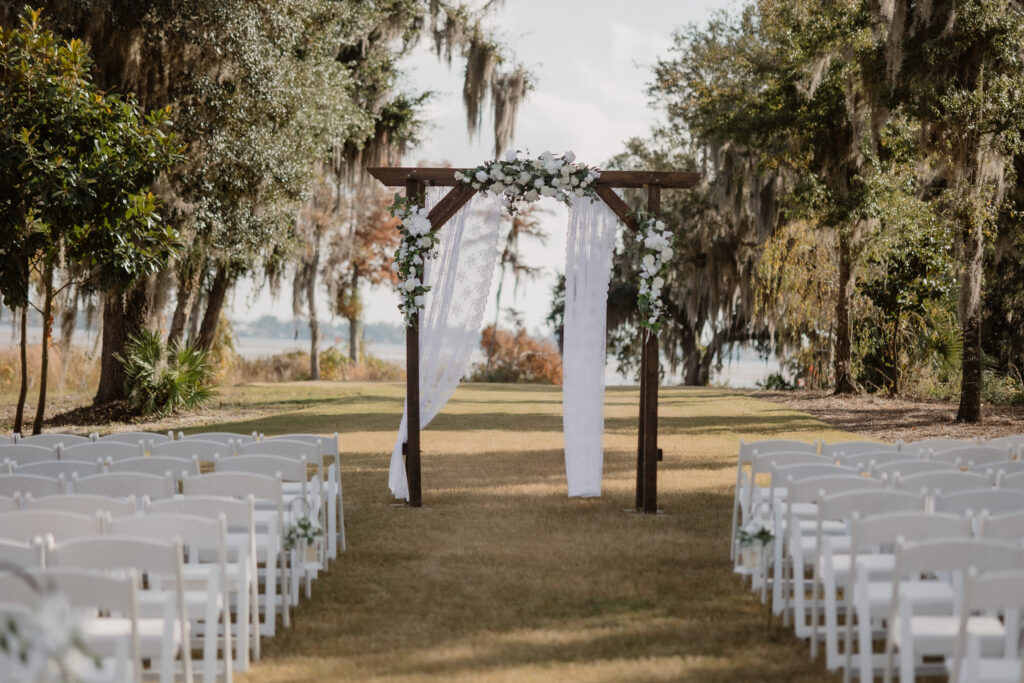
Venue Types on the Gulf Coast: What They Mean for Your Budget
Where you celebrate changes what you spend—not just on the venue itself, but across every category it touches. Here’s how common Gulf Coast venue types affect the overall cost picture.
Public Beach Ceremony (Walton County / 30A Region)
The appeal is obvious: iconic Gulf Coast scenery, barefoot vows, the sound of the surf. The permit system in Walton County uses an attendance-based fee tier and a calendar approach designed to prevent multiple weddings from stacking at the same place and time. Cost drivers include the permit fee, rentals for every element (chairs, arch, aisle treatment, portable sound), wind-stable floral mechanics, teardown labor, and often “leave no trace” cleanup expectations.
For photo and film: prioritize lavalier audio with wind protection. Build buffer time for beachgoer foot traffic. Golden-hour timing governs your portrait block.
National Park Beach (Gulf Islands National Seashore)
Established pavilion facilities come with listed daily rates—$200 for the Johnson Beach Pavilion, $300 for Opal Beach pavilions—plus potential special use permits depending on the group size and event scope. Entrance fees apply separately. Park rules and public access affect privacy, so plan for a documentary-style approach rather than a “hard hold” on the space.
Luxury Resort (Henderson Beach Resort, Hilton Sandestin)
Resorts function as one-stop production ecosystems. Henderson Beach Resort lists event spaces with specific capacities (the Grand Lawn holds up to 175 guests, for example), and the property provides infrastructure that a beach ceremony doesn’t—power, catering, indoor backup, staffing, and a coordinated event team. The per-event cost is higher, but the scope of what’s included is dramatically larger, and the number of separate vendors you need to source shrinks.
For photo and film: ideal for full-day storytelling. Easier audio capture through the venue’s AV system. Consistent Plan B reduces weather risk and the need for contingency spending.
Boutique Beachfront Hotel (The Pearl Hotel, Rosemary Beach)
The Pearl Hotel offers multiple venue spaces with capacities up to approximately 125 guests, including the Pearl Ballroom and the Cabana Rooftop. The compact property layout reduces transport time between moments, which is a subtle but real cost saver—fewer transit minutes means fewer coverage hours needed and a tighter, more relaxed timeline.
For photo and film: rooftop events need wind-aware audio strategy, but the intimate scale produces beautiful, personal coverage.
Frequently Asked Questions
How much does a Gulf Coast wedding cost in 2026?
The most current national benchmark is $34,200 (The Knot, 2026 Real Weddings Study). Gulf Coast weddings can fall above or below this depending on guest count, venue type, season, and how much outdoor infrastructure is required. The per-guest average of $292 is a useful planning number—multiply it by your expected headcount for a rough catering-and-venue baseline, then layer in vendor costs, rentals, and contingency.
Do I need a permit for a beach wedding near Destin or 30A?
It depends on the exact location. City of Destin public beaches do not permit special events. Walton County (covering 30A and South Walton) has an attendance-based permit fee system. Okaloosa County has its own permit guidance. And federal parkland (Gulf Islands National Seashore) requires National Park Service special use permits. Always confirm the jurisdiction of your specific ceremony location and apply early—especially for peak-season dates.
How much should I budget for wedding photography and videography?
The Knot’s baseline is approximately 10% of your total budget, which on a $34,200 average translates to roughly $3,400 combined. For couples who prioritize their wedding imagery and want an experienced team with Gulf Coast–specific expertise, the investment is often higher—especially when multi-location timelines, beach ceremony audio, and extended coverage hours are involved. For a detailed breakdown of what different investment levels deliver, see our guide to wedding photography costs in 2025 for Destin, 30A, and beyond.
What months are riskiest for weather on the Gulf Coast?
Hurricane season runs June 1 through November 30, with peak activity historically concentrated in August through October. Afternoon thunderstorms are most common from June through September. This doesn’t mean you should avoid these months—but your planning should include genuine weather contingencies, appropriate contract language, and consideration of event insurance.
What time should our ceremony start for golden-hour portraits?
Plan for your ceremony to end 20–40 minutes before sunset, which gives you time to transition into portraits while the light is still warm and flattering. Use the sunset table above to find the baseline for your month, then confirm the exact sunset for your date using the NOAA Solar Calculator. In June and July, that means a ceremony could start as late as 6:00 PM. In December, you may need to begin by 3:00 PM.
Should I get wedding insurance for a Gulf Coast wedding?
It’s worth evaluating, especially if your wedding falls during hurricane season or involves significant deposits with multiple vendors. Cancellation and postponement coverage can reimburse lost deposits and costs when circumstances beyond your control force a change of plans. Policy terms vary—read them carefully and purchase early in your planning process.
A Budget That Works Feels Like Freedom
The goal of a good wedding budget isn’t to spend less. It’s to spend intentionally—to know where the money goes, why it goes there, and to feel confident that every dollar is building the day you actually want.
On the Gulf Coast, that means planning for the environment you’re marrying in. The wind, the heat, the light, the permits, the logistics—these aren’t obstacles. They’re the characteristics of one of the most beautiful wedding destinations in the country. When you budget for them honestly, they become part of the story instead of a source of stress.
At White Sands Weddings, we help couples navigate all of this—not just the photography and film, but the timeline, the coverage plan, the audio strategy, and the logistics that make the difference between a day that feels rushed and one that feels like it’s floating. We’ve worked weddings from Destin and 30A to Panama City Beach and Orange Beach, and we know what this coastline asks of a celebration—and what it gives back.
Ready to talk about your day? Check your date and let’s build a coverage plan that fits your vision, your timeline, and your budget.
Want more planning tools? See our guides to building a Gulf Coast wedding-day timeline and choosing between a beach wedding and a venue wedding for the full picture.
Matthew Oakes
Founder & Filmmaker, White Sands Weddings
info@whitesandsweddings.com
Sources and Further Reading
- The Knot – Average Wedding Cost (2026 Real Weddings Study) — data-backed national average of $34,200
- The Knot – Wedding Budget Breakdown — category allocation percentages based on real couples’ data
- Zola – Average Cost of a Wedding in 2026 — secondary national benchmark
- Brides – Wedding Budget Allocation — alternative budget framework
- The Knot – Wedding Insurance — cancellation and postponement coverage guidance
- National Hurricane Center – Hurricane Season — official Atlantic hurricane season dates (June 1 – November 30)
- NWS – Heat Index Guidance — heat index planning for outdoor events
- City of Destin – Beach Weddings Fact Sheet — public beach event rules and restrictions
- Walton County – Outdoor Event Permits — 30A / South Walton beach wedding permit fees (attendance-based tiers)
- Okaloosa County – Wedding Permits — county beach and park event guidance
- NPS – Gulf Islands National Seashore Permits — federal special use permits and pavilion rates
- Henderson Beach Resort – Event Venues — Destin luxury resort venue example
- The Pearl Hotel – Weddings — Rosemary Beach boutique venue example
- NOAA Sunrise/Sunset Calculator — generate exact sunset times for your wedding date
- timeanddate.com – Destin Sunrise/Sunset — month-by-month sunset baselines


