


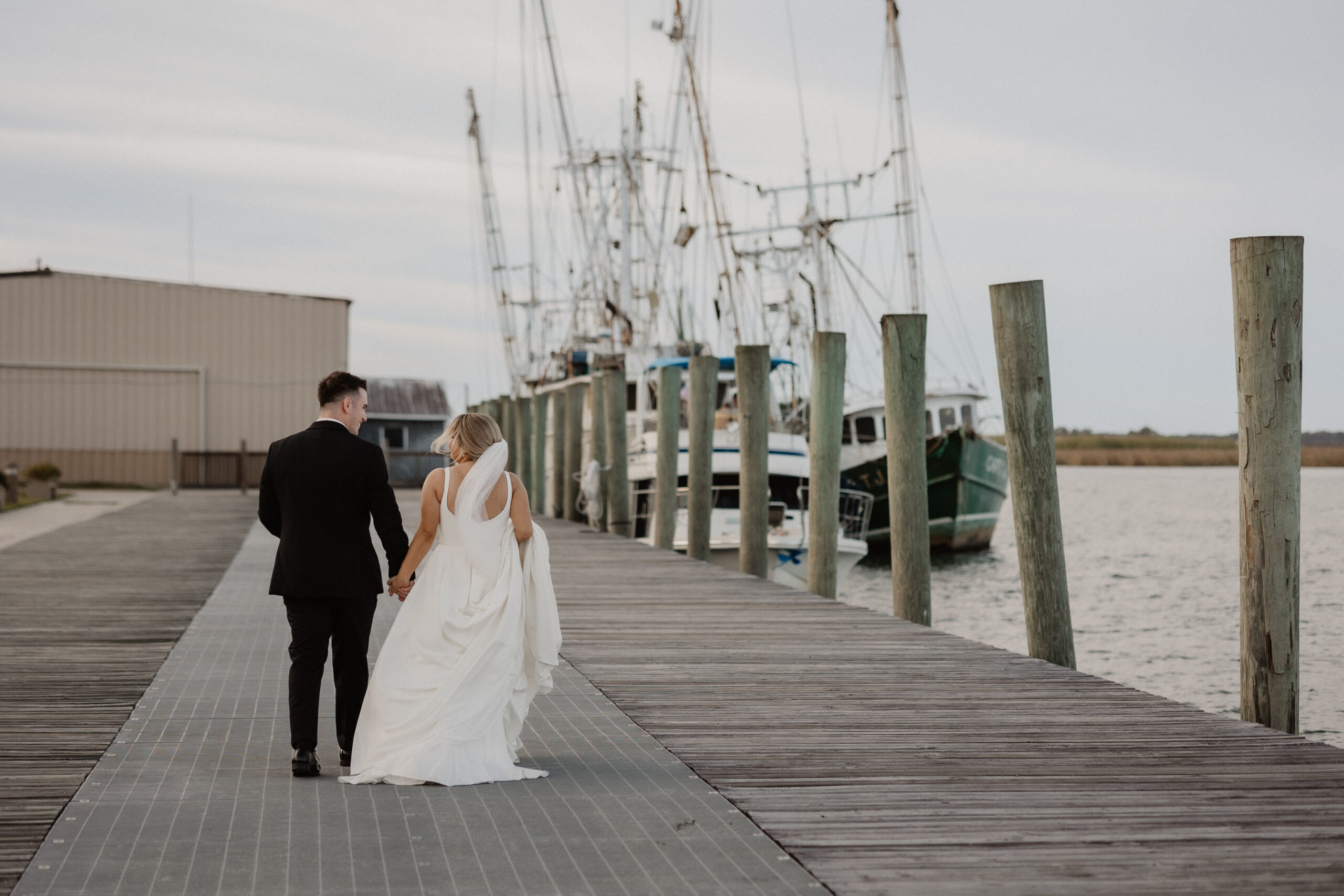
Imagine this: the Gulf is glassy, the sand is sugar-white, and your guests are already exhaling—because the whole day feels like a vacation. That’s the dream behind a beach wedding on the Gulf Coast. And it’s a beautiful dream. We’ve filmed it, photographed it, and lived inside those golden-hour moments with couples from Destin to Orange Beach.
But here’s the part that doesn’t make it onto Pinterest: the beach is also a living, breathing environment with wind that rearranges your veil, wildlife protections that dictate where you can set up, sound challenges that can swallow your vows before they reach the second row, and permitting rules that vary dramatically depending on which stretch of sand you’re standing on.
On the other hand, a venue wedding, especially at a luxury resort or a thoughtful indoor-outdoor property on the Gulf Coast, can feel like someone quietly turned the difficulty setting down. Your timeline runs smoother. Your guests stay comfortable. Your photo and film team can focus entirely on storytelling instead of troubleshooting. And if you still want beach portraits (you absolutely can), you build in a golden-hour slip-out and get the Gulf in your gallery without the logistical weight of a full beach ceremony.
The right answer isn’t about which option is “better.” It’s about what’s right for your priorities, your guest list, and the experience you want the day to carry. This guide walks through the decision the way we do it with our own couples—using real permit rules, real sunset timing, and real-world production considerations—so you can choose with confidence and build a plan that photographs like a dream and runs like a production.
The Quick Answer
If you’re short on time and just want the headline version, here it is. But we’d encourage you to read the full guide, because the details are where couples either feel prepared or get caught off guard.
Choose a Beach Wedding If…
You want the Gulf Coast itself to be the centerpiece of the day—the water, the sand, the wide-open sky as your ceremony backdrop. You have a relatively small guest count (under 75 is the sweet spot for a smooth beach ceremony, though larger celebrations can absolutely work with the right planning). Your guests are mostly mobile and comfortable with an outdoor setting. You’re willing to invest the planning energy into permits, audio strategy, wind mitigation, and a genuine weather Plan B. And you’re excited—not stressed—by the idea that the day will have a slightly wild, natural character to it.
A well-planned beach wedding on the Gulf Coast is one of the most beautiful things we’ve ever photographed. It just requires more intentional logistics than most couples expect.
Choose a Venue Wedding If…
You want control—over the timeline, the sound, the temperature, the lighting, and the guest experience from start to finish. You have a larger guest count, guests with mobility considerations, or a preference for seamless transitions between ceremony, cocktails, and reception. You value having a built-in Plan B for weather without having to engineer one from scratch. And you want your photo and video team focused purely on capturing the moments, not managing the environment.
A Gulf Coast venue wedding doesn’t mean giving up the water. Many of the best venues here sit directly on the beach, and sunset portrait sessions on the sand are always part of the plan. You’re choosing comfort and consistency for the ceremony and reception, while still getting the Gulf in your gallery.
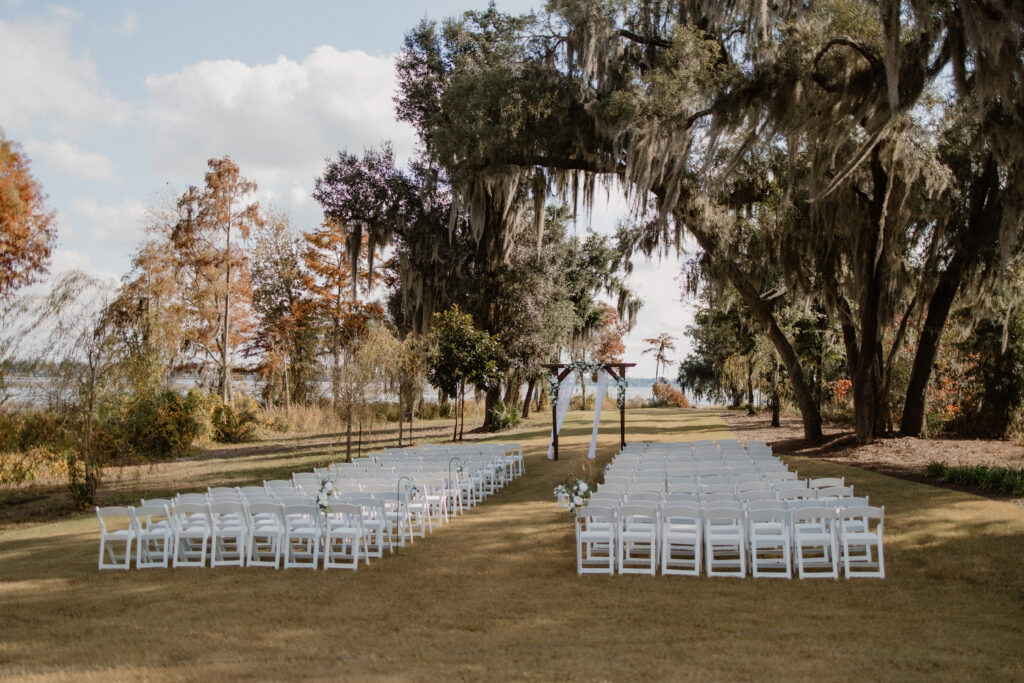
Beach Wedding on the Gulf Coast: What It’s Really Like
The romance of a beach wedding is undeniable. Barefoot vows, salt air, the sound of the surf behind you, the sky doing something extraordinary as the sun drops toward the horizon. We understand the pull—it’s why so many couples come to Destin, 30A, Pensacola Beach, and Orange Beach to get married in the first place.
But the romance works best when it’s supported by realism. Here’s what a beach ceremony actually involves on the Gulf Coast, and why the logistics differ so much from what you’d face at a traditional venue.
Guest Comfort, Accessibility, and Parking Realities
Sand is not an accessible surface. That’s not a judgment—it’s a planning fact. Guests in heels, guests with walkers, elderly grandparents, small children in strollers—all of them will have a harder time getting to and standing at a beach ceremony than they would at a venue with paved paths, ramps, and climate-controlled spaces. If accessibility matters to your guest list (and it should), you’ll need to think carefully about beach access points, whether ADA-compliant boardwalks or mats are available at your specific location, and what restrictions exist on bringing vehicles or carts onto the sand.
Restrooms are the other invisible challenge. Public beach locations rarely have dedicated restroom facilities at the ceremony site. That means porta-potties (which have their own permitting and aesthetic considerations) or directing guests to the nearest public restroom, which may be a meaningful walk away. At a venue, restrooms are built into the infrastructure and available twenty steps from where your guests are seated.
Parking is the third factor. Public beaches and parks can reach capacity on busy weekends, and access hours may be limited—some locations close to day visitors at sundown, which directly affects your timeline for a sunset ceremony. If your beach ceremony is at a popular public access point on a Saturday in June, your guests may be competing with beachgoers for parking.
None of these are deal-breakers. But they’re the kind of details that separate a beach wedding that feels like a dream from one that feels like an obstacle course for half your guest list.
Wind, Sound, and Why Beach Ceremonies Need a Different Production Approach
On the Gulf Coast, wind is not an edge case. It’s a design constraint.
The sea breeze—a thermally driven daytime wind that blows from the cooler Gulf toward the warmer land as temperatures rise—typically builds through the afternoon and is often at its strongest during the late afternoon hours that coincide with most ceremony times (NWS – Sea Breeze Definition). A related phenomenon, the sea-breeze front, can bring sudden wind shifts, quick temperature drops, and even passing showers as it moves inland (NWS – Sea Breeze Front). The sea breeze can also help trigger convection—the mechanism behind afternoon thunderstorms—which is why coastal planners watch timing and radar closely during summer months (NWS – Sea Breeze Science).
What does this mean for your ceremony? Three things.
First, your vows are competing with the wind and the surf. Guests beyond the third or fourth row may not hear a word unless you’ve planned for it. An officiant speaking into the wind, with waves crashing behind them, in front of fifty guests spread across the sand? That’s a recipe for a beautiful visual with no audible vows.
Second, your wedding film depends on clean audio. From a videography perspective, wind noise is one of the most significant challenges of beach ceremonies. It affects vow intelligibility, mic placement, and whether the final film captures the emotional weight of what you said to each other—or just the sound of rushing air. Microphone manufacturers are clear on this: windscreens are essential for outdoor recording, and the right wind protection can reduce wind noise substantially.
The takeaway for couples: a beach ceremony benefits from audio redundancy. At minimum, we recommend a lavalier mic on the officiant, a lavalier on the groom (which naturally captures the bride’s voice during face-to-face vows), a backup recorder as a safety net, and wind protection on every microphone. For larger guest counts, a dedicated audio technician monitoring levels throughout the ceremony is the difference between a film with crisp, emotional vow audio and one where you’re reading subtitles.
Third, wind affects everything visual. Veils, hair, florals, ceremony arches, table décor at a beach reception—all of it is subject to the Gulf breeze. The most “hair-down, veil-flowing” portraits should be scheduled for earlier in the day in a sheltered area, or you need to embrace the wind as part of the aesthetic (which can look stunning when your team is ready for it). Ceremony arches and structures need to be engineered for wind—not just pretty, but anchored.
A venue wedding largely eliminates these sound and wind concerns. Indoor ceremonies give you controlled acoustics. Even outdoor venue ceremonies (courtyards, terraces, covered pavilions) typically offer some wind protection from surrounding architecture. And for your film, that controlled environment means the audio of your vows comes through with the clarity and emotion you’ll want to hear for the rest of your lives.
Permits and Restrictions: The Biggest Gulf Coast Differentiator
This is the section that separates this guide from every generic “beach vs. venue” article on the internet. On the Gulf Coast, beach wedding permits are not one thing. They are multiple legal contexts—city, county, state, and federal—and the rules vary dramatically depending on which stretch of sand you choose.
City-controlled public beaches can prohibit special events outright or impose strict constraints. The City of Destin’s Beach Event Fact Sheet, for example, states that no special events are permitted on City of Destin public beaches, and it lists specific constraints affecting décor, generators, structures, noise levels, and sea turtle protections (City of Destin – Beach Weddings Fact Sheet). This is critical for couples who assume “Destin beach wedding” means setting up an arch on any stretch of public sand. The city’s rules on generators, amplified sound, and temporary structures can materially change what your ceremony looks like—and whether it can happen at all on public beach property.
A related note on sea turtle protections: nesting season runs roughly May through October on the Gulf Coast, and regulations can restrict lighting, activity near marked nests, and the types of equipment used on the beach after dark. The Destin fact sheet specifically addresses these protections, and if your wedding falls in nesting season, you need to factor these rules into your timeline and décor plan.
County beaches and parks operate under different frameworks. South Walton and the 30A corridor fall under Walton County, which publishes beach event fee tiers that scale with attendance—an important detail for couples budgeting a wedding in this area (Walton County – Outdoor Event Permits). Okaloosa County (covering Destin, Fort Walton Beach, and Okaloosa Island) publishes its own wedding and special event permit guidance, recommending that couples contact them at least 14 days in advance (Okaloosa County – Wedding Permits). County permits may also require proof of insurance, hold-harmless agreements, and in some cases, leaseholder approvals depending on the specific site.
Pensacola Beach is managed by the Santa Rosa Island Authority (SRIA), which publishes its own wedding guidelines. Notably, SRIA’s approach includes a “courtesy notification” system for ceremonies themselves—meaning you may not need a formal permit for just the ceremony—but it also includes specific rules about tent sizing, décor restrictions, and keeping setups away from public access paths (SRIA – Pensacola Beach Wedding Guidelines). It’s a different framework than what you’ll encounter in Destin or along 30A, and couples planning a Pensacola Beach ceremony should read the SRIA guidelines carefully.
State park beaches introduce yet another layer. Gulf State Park in Alabama, for instance, requires permits for all weddings and includes restrictions on music, glass, vehicles, and—importantly—a “sundown” closure that affects late-evening timelines (Gulf State Park – Wedding Guidelines). If you’re planning a beach ceremony at a state park, the sundown closure can be the single biggest factor in your timeline design, because it means your ceremony and portraits must be complete before the park closes for the day. Grayton Beach State Park, one of the most photographed locations on 30A, falls under the Florida State Parks system (Grayton Beach State Park), and couples should confirm current permitting requirements directly.
Federally managed beaches are the final category. The Gulf Islands National Seashore—which includes Johnson Beach and Fort Pickens, among other stunning locations—requires special use permits through the National Park Service, with the park preferring at least two weeks of lead time for processing (NPS – Gulf Islands National Seashore Permits). These permits are often overlooked in generic wedding blogs, but if you’re drawn to the more remote, pristine stretches of coastline, this is likely federal land—and the rules apply.
A venue wedding shifts most of this burden. A traditional venue—whether it’s a resort, hotel, estate, or ballroom—is designed for events. The “public space” compliance layer largely disappears. Your event is governed by your venue contract and local ordinances rather than by beach-specific restrictions on generators, structures, sound, and wildlife. The permitting conversation is replaced by a venue coordinator conversation, and the logistical complexity drops significantly.
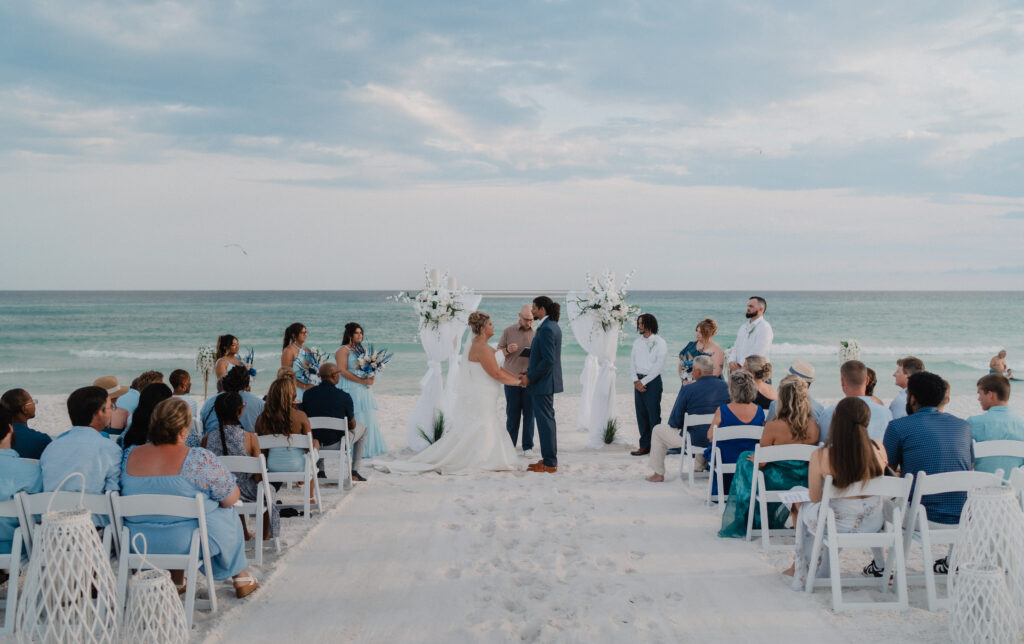
Venue Wedding on the Gulf Coast: What You Gain
If the previous section reads like a list of challenges, that’s partly the point. Not to discourage beach weddings—we love them—but to make sure the decision is made with open eyes. A venue wedding on the Gulf Coast offers a different set of advantages, and for many couples, those advantages are exactly what let the day feel relaxed, beautiful, and effortless.
Control: Weather, Power, Timelines, and Transitions
The single biggest advantage of a venue wedding is control. You control the climate (air conditioning exists, and your guests will be grateful for it in July). You control the lighting (both natural and designed). You control the power supply (no permit restrictions on generators, because the building has outlets). You control the timeline transitions (ceremony to cocktails to reception without shuttling guests across a parking lot and down a boardwalk).
For your photo and video team, this control translates directly into better coverage. When we’re not troubleshooting wind, sand in the gear, or a sudden rain cell, we’re focused entirely on the storytelling—the quiet glance during the first look, the father wiping his eyes, the moment the couple sees the reception room for the first time. That focus shows up in the final gallery and film.
Access: Restrooms, Shaded Prep Space, and Indoor Plan B
Venue weddings come with infrastructure that beach weddings simply don’t. Restrooms are steps away. Bridal suites have mirrors, lighting, and climate control for getting-ready coverage. Cocktail spaces have shade, seating, and a bar setup that doesn’t involve anchoring anything to sand.
And then there’s Plan B. Most quality Gulf Coast venues provide indoor backup spaces as part of the event package. If a storm rolls in at 4:30 PM—which happens regularly during summer months—you move the ceremony indoors, adjust the lighting, and the day continues without a crisis. The ceremony still happens. The vows still sound beautiful. The photos still tell the story. Your guests never stood in the rain wondering what to do. Confirm the specifics of your venue’s Plan B in your contract, because this detail alone can save your entire wedding day experience.
Visual Tradeoffs: Interiors, Lighting Design, and Ceremony Backdrops
Couples sometimes worry that choosing a venue means losing the visual magic of the Gulf Coast. It doesn’t—it just changes the visual language.
Venue ceremonies offer architectural backdrops, designed lighting, and interior textures (stone, wood, drapery, chandeliers) that create a completely different kind of beauty. They photograph with depth, warmth, and intimacy. And because your photographer isn’t fighting harsh sun angles or racing a setting sun, there’s more time to compose, to wait for the right expression, to get the shot that stops you in your tracks.
Meanwhile, the Gulf Coast is still right outside. A fifteen-minute sunset portrait session on the beach—planned into your timeline as a golden-hour slip-out—gives you the iconic Gulf imagery in your gallery without the ceremony-day logistics of a full beach event. It’s the best of both worlds, and it’s one of the most popular approaches among our couples.
The Gulf Coast has venue options that make this seamless. Beachfront resorts like Henderson Beach Resort in Destin offer indoor and outdoor ceremony spaces with immediate beach access for portraits. Properties like WaterColor Inn & Resort on 30A let you keep the entire day on one property with a coastal aesthetic built into every corner. Perdido Beach Resort in Orange Beach puts the ceremony, reception, and beach portraits all within walking distance. These aren’t compromises—they’re venues designed to give you the Gulf Coast atmosphere with the infrastructure of a professional event space.
Side-by-Side Comparison: Beach vs. Venue at a Glance
For couples who want the decision laid out plainly, here’s how beach weddings and venue weddings compare across the logistics that matter most—especially for photography and film.
Logistics and Timeline Stress Points
| Category | Beach Wedding (Public Beach / Park) | Venue Wedding (Resort / Hotel / Estate) |
|---|---|---|
| Permits & Legal | Jurisdiction-specific; may involve restrictions on structures, generators, music, noise, and protected wildlife zones. Rules vary by city, county, state, and federal management. | Governed by venue contract and local ordinances; fewer “public space” restrictions. Permitting burden is largely handled by the venue. |
| Sound & Audio | Wind and surf compete with vows; wind protection and redundant audio recording are essential. Amplified sound may be restricted by location rules. | More controlled acoustics; indoor options reduce wind; still plan a mic strategy for clarity, but the environment is far more predictable. |
| Weather Plan B | Requires a genuine go/no-go plan with identified shelter for lightning safety. If shelter access is uncertain, the functional Plan B may be “venue ceremony.” | Most quality venues provide indoor backup spaces; confirm details in your contract. The transition from outdoor to indoor is typically seamless. |
| Guest Accessibility | Depends on beach access points, boardwalks, mats, and allowed devices. Sand is not an accessible surface for all guests. Some areas restrict vehicles. | Generally better: restrooms, ramps, climate control, and paved paths are standard. Confirm specifics with your venue. |
| Parking & Crowding | Public beaches and parks can reach capacity; access hours may be limited (some locations close at sundown). Guests may compete with the public for parking. | Controlled parking and shuttles are more common. Dedicated event parking reduces friction. |
| Décor & Setup | Wind-safe décor is required. Restrictions may prohibit digging, temporary structures, or certain materials. Cleanup expectations are strict, especially on public land. | More décor flexibility. Venue staff often assists with setup logistics and has experience managing event installations. |
| Vendor Load-In | Longer load-in times due to beach access, sand navigation, and equipment protection. Audio setup takes additional time for wind checks. | Standard load-in with paved access, power, and covered areas. Equipment stays protected. |
Photo and Video Priorities by Setting
The setting doesn’t change what matters in your photos and film—the emotion, the connection, the story—but it does change how your team captures it.
On the beach, your photo and video team is managing natural light that changes by the minute, wind that affects every piece of gear and every frame, audio that requires constant monitoring, and a timeline that’s tied to sunset with less margin for error. The images can be extraordinary—some of the most stunning work in our portfolio comes from beach ceremonies—but the production effort is higher, and the team needs to be experienced with outdoor Gulf Coast conditions specifically.
At a venue, the production environment is more stable. Light can be supplemented or shaped. Audio is cleaner. Transitions between moments are shorter. The team can work with more intention and less reactive energy, which often translates into a deeper, more varied gallery—more quiet moments captured, more candids noticed, more creative compositions attempted.
If you choose a beach ceremony, make sure your photo and video team has real Gulf Coast experience—not just “outdoor wedding” experience. Shooting on the Gulf Coast is a specific skill set, and the difference between a team that knows how to manage it and one that’s figuring it out on your wedding day will show up in every frame.
Best Times of Year and Best Ceremony Times on the Gulf Coast
Whether you choose beach or venue, timing matters. The Gulf Coast’s light changes dramatically across the year, and the weather patterns shift with it. Here’s the data you need to make a smart decision.
Sunset-by-Month Table: Four Gulf Coast Locations
The table below uses mid-month (15th) sunset times as baselines for 2026, derived from timeanddate.com monthly sun tables. All times are Central Time.
| Month | Destin | 30A (Santa Rosa Beach) | Pensacola | Orange Beach |
|---|---|---|---|---|
| January | 5:07 PM | 5:06 PM | 5:10 PM | 5:12 PM |
| February | 5:34 PM | 5:33 PM | 5:37 PM | 5:38 PM |
| March | 6:54 PM | 6:53 PM | 6:57 PM | 6:58 PM |
| April | 7:13 PM | 7:12 PM | 7:16 PM | 7:17 PM |
| May | 7:33 PM | 7:32 PM | 7:36 PM | 7:37 PM |
| June | 7:49 PM | 7:48 PM | 7:52 PM | 7:53 PM |
| July | 7:49 PM | 7:48 PM | 7:52 PM | 7:53 PM |
| August | 7:27 PM | 7:26 PM | 7:30 PM | 7:31 PM |
| September | 6:51 PM | 6:50 PM | 6:54 PM | 6:55 PM |
| October | 6:14 PM | 6:13 PM | 6:17 PM | 6:19 PM |
| November | 4:49 PM | 4:48 PM | 4:51 PM | 4:53 PM |
| December | 4:47 PM | 4:46 PM | 4:49 PM | 4:51 PM |
How to use this for ceremony planning. For a sunset-forward ceremony, plan for the ceremony to end 20 to 40 minutes before sunset so you can transition into portraits while the light is still warm and flattering. If your ceremony location and portrait location are in different places (common for venue weddings with a beach portrait session), you’ll need transit time built in. For your exact wedding date, generate precise sunrise and sunset tables using the NOAA Solar Calculator—it’s the most reliable source available.
June and July offer the latest sunsets—nearly 7:50 PM—giving you the longest afternoon and the most flexibility in your timeline. November and December sunsets arrive before 5:00 PM, which means an early-afternoon ceremony and a very different pace to the day. Neither is better or worse, but they demand different timelines, and the sunset table is where that planning starts.
Hurricane Season, Lightning Safety, and What We Do on Storm Days
Hurricane season runs June 1 through November 30 according to the National Hurricane Center (NHC). This isn’t a reason to avoid a summer or fall wedding—the vast majority of Gulf Coast wedding weekends during these months go beautifully. It is a reason to include weather contingency language in your vendor contracts and to have a communication plan in place in case a named storm disrupts the week leading up to your day.
Lightning safety is non-negotiable. The National Weather Service is clear: if you can hear thunder, you are close enough to be struck by lightning, and outdoor activity should not resume until 30 minutes after the last observed thunder or lightning (NWS – Lightning Safety). For a beach ceremony with no nearby shelter, this guidance means the functional Plan B is to move the ceremony indoors if a storm cell is approaching. For a venue ceremony with an outdoor component, it means having the indoor backup ready to activate without panic.
On storm days, here’s what an experienced photo and video team does: we watch the radar, communicate with the couple and planner in real time, and execute the contingency plan calmly. Gulf Coast afternoon storms are often brief—30 to 60 minutes—and some of the most dramatic skies we’ve ever captured happen in the hour after a storm clears. A well-built timeline can absorb a weather delay and still deliver every moment that matters.
Frequently Asked Questions
Do I need a permit for a beach wedding in South Walton / 30A?
Yes. Walton County manages beach events in the South Walton and 30A corridor and publishes outdoor event permit requirements with fee tiers that scale by guest count (Walton County – Outdoor Event Permits). Apply early, especially for peak-season dates.
Can we have a wedding on Destin’s public beaches?
This requires careful planning. The City of Destin’s Beach Event Fact Sheet states that no special events are permitted on City of Destin public beaches and outlines specific restrictions affecting décor, generators, structures, and noise (City of Destin – Beach Weddings Fact Sheet). However, private property along the beach may have different rules, and adjacent county-managed areas have their own permitting systems. If you want a beach ceremony near Destin, research the specific jurisdiction of your chosen location carefully—city, county, and private property are all distinct.
Do we need a permit for a Pensacola Beach ceremony?
Pensacola Beach is managed by the Santa Rosa Island Authority (SRIA), which publishes wedding guidelines that include a courtesy notification approach for ceremonies, along with rules about tent sizing and décor (SRIA – Wedding Guidelines). Read the current guidelines directly and contact SRIA with questions about your specific setup.
Do state parks require permits? Do beaches close at sundown?
State parks generally require permits for weddings. Gulf State Park in Alabama, for example, requires permits for all weddings and includes a sundown closure, restrictions on music, glass, and vehicles (Gulf State Park – Wedding Guidelines). The sundown closure is particularly important—if your ceremony is at a state park, your entire portrait session must be complete before the park closes. Confirm current rules directly with the specific state park.
What if it’s windy—will guests hear the vows?
If you don’t plan for it, probably not. Gulf Coast sea breezes build through the afternoon and can make unamplified vows inaudible beyond the first few rows. The solution is a combination of mic strategy (lavalier mics on the officiant and groom, backup recorder, wind protection on everything), ceremony orientation (angle the setup so the wind is at the couple’s back, not blowing into their microphones), and tighter seating arrangements. If amplified sound is permitted at your location, a small PA system helps guests hear in the moment—but your film audio still depends on the mic strategy regardless.
What happens if there’s lightning on the radar?
You move indoors immediately. The National Weather Service guidance is unambiguous: if you can hear thunder, you are close enough to be struck, and outdoor activity should not resume for 30 minutes after the last thunder or lightning (NWS – Lightning Safety). Your timeline should include an identified shelter location and a plan for how to transition guests quickly if a storm cell approaches. This is especially critical for beach ceremonies, where shelter may not be immediately adjacent.
What months have the latest sunsets on the Gulf Coast?
June and July, when sunset falls around 7:48–7:53 PM depending on your exact location along the coast. This gives you the latest ceremony start times and the most afternoon flexibility. November and December have the earliest sunsets—around 4:47–4:53 PM—which means early-afternoon ceremonies and a fundamentally different timeline structure. See the full sunset table above for all twelve months across four Gulf Coast locations.
Do we need to worry about sea turtle rules?
If your ceremony is on a public beach during nesting season (roughly May through October), yes. The City of Destin’s beach event fact sheet specifically addresses sea turtle protections, including restrictions near marked nests and requirements for red-light flashlights after dark (City of Destin – Beach Weddings Fact Sheet). Even if your specific beach doesn’t have posted turtle rules, it’s good practice to avoid disturbing marked nest areas and to use wildlife-friendly lighting for any evening beach activity.
Can I have a beach ceremony and a venue reception?
Absolutely—and it’s one of the most popular approaches for couples who want the iconic Gulf Coast ceremony backdrop without the logistical challenges of a full beach reception. Plan for realistic transit time between the beach and the venue (Gulf Coast traffic on a Saturday can add meaningful time), and make sure your timeline protects the portrait window so you’re not racing from one location to the next.
Your Day, Your Way—With the Right Information
The choice between a beach wedding and a venue wedding on the Gulf Coast isn’t about settling. It’s about choosing the experience you actually want—and building a plan that delivers it without surprises.
If you choose the beach, go in with your eyes open. Know the permit rules for your exact location. Plan the audio strategy before your vendor team arrives. Build a real weather contingency—not a vague hope. And hire a photo and video team that knows this coastline intimately, because the Gulf Coast is a specific environment, and experience here matters.
If you choose a venue, know that you’re not sacrificing the Gulf Coast magic. You’re gaining control, comfort, and consistency—and your sunset portrait session on the sand will still be one of the most beautiful sets of images in your gallery.
And if you’re still not sure? That’s exactly where we come in.
At White Sands Weddings, we photograph and film both beach ceremonies and venue celebrations across the Gulf Coast—from Destin and 30A to Panama City Beach, Pensacola, and Orange Beach. We’ve seen what works, what breaks, and what makes the difference between a day that feels chaotic and one that feels like it’s floating. We’d love to help you build a plan that fits your vision and runs like a production.
Ready to start planning? Check your date and let’s talk about what your day could look like.
Want to see the difference? Browse our recent galleries and films to see beach ceremonies and venue celebrations we’ve captured along the Gulf Coast.
Matthew Oakes
Founder & Filmmaker, White Sands Weddings
info@whitesandsweddings.com
Sources and Further Reading
- NOAA Sunrise/Sunset Calculator — generate exact sunrise and sunset tables for your wedding date
- National Hurricane Center – Hurricane Season — official Atlantic hurricane season dates (June 1 – November 30)
- NWS – Lightning Safety — the 30-minute rule for outdoor events
- timeanddate.com – Destin Sunrise/Sunset — month-by-month sunset baselines
- NWS – Sea Breeze Definition — what drives afternoon Gulf Coast winds
- NWS – Sea Breeze Front — why wind shifts bring sudden showers
- NWS – Sea Breeze Science — how sea breezes trigger convection and storms
- City of Destin – Beach Weddings Fact Sheet — Destin public beach event rules and restrictions
- Walton County – Outdoor Event Permits — 30A / South Walton beach wedding permit fees
- Okaloosa County – Wedding Permits — Destin-area county beach and park event guidance
- SRIA – Pensacola Beach Wedding Guidelines — Pensacola Beach ceremony and event rules
- Gulf State Park – Wedding Guidelines — Alabama state park permit rules and sundown closure
- Grayton Beach State Park — Florida state park info for one of 30A’s most popular ceremony locations
- NPS – Gulf Islands National Seashore Permits — federal special use permits for beach weddings
- Shure – Wind Noise Reduction — professional guidance on outdoor microphone wind protection
- Sennheiser – Using the Windshield — lavalier wind protection effectiveness
- RØDE – Reducing Wind Noise — practical outdoor wind-noise mitigation strategies
- Henderson Beach Resort – Event Venues — Destin beachfront venue example
- WaterColor Inn & Resort – Weddings — 30A resort venue example
- Perdido Beach Resort – Events — Orange Beach beachfront venue example


