


Every couple who plans a Gulf Coast wedding wants the sunset in their photos. However, here’s what most don’t realize until they’re standing on the sand: this stretch of coastline doesn’t give you the sunset the way you might expect.
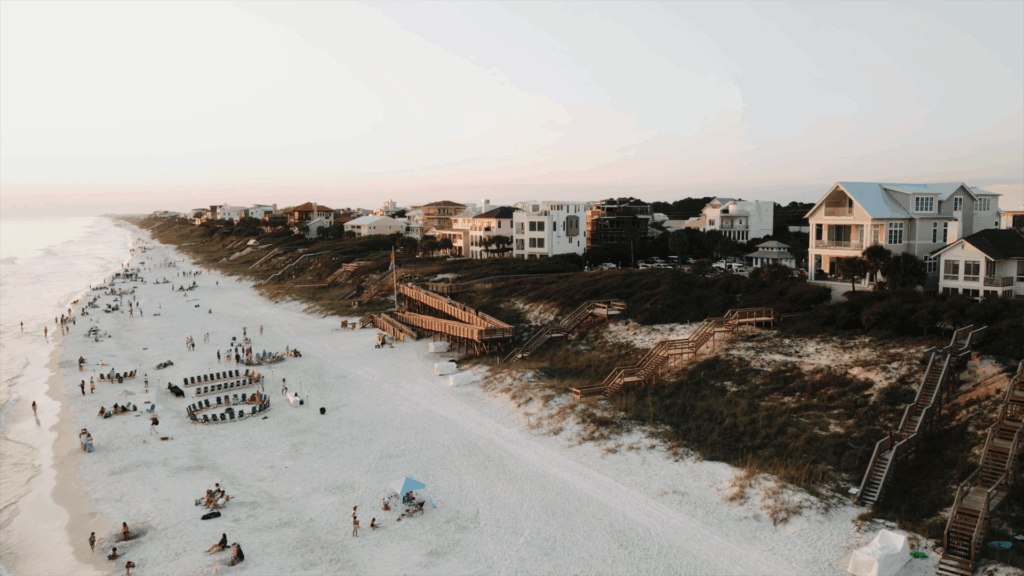
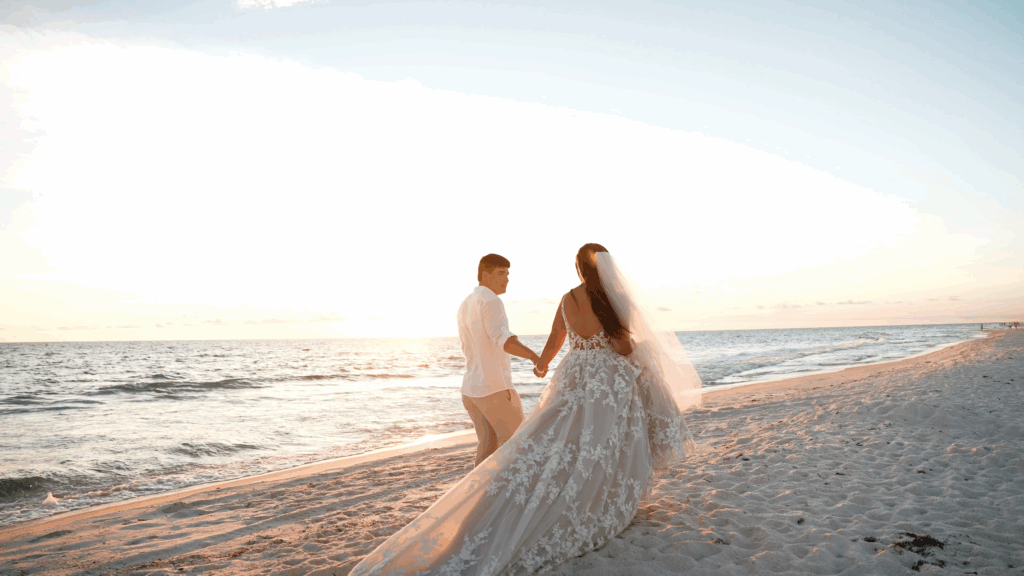
From Destin through 30A, Pensacola Beach, and Orange Beach, the beaches face south—not west. In other words, the Gulf of Mexico is in front of you. Meanwhile, the sunset is to your right. Unlike Naples or Clearwater, where the beaches face due west and the horizon swallows the sun in a straight line, the sun doesn’t drop into the water the way it does there. On this coast, the sunset travels along the water at an angle, painting the sky in a wide arc from the west while warm, directional light skims across your faces from the side.
And that side-lighting? It’s actually better for photography than a direct sunset behind you. Specifically, it sculpts faces, creates depth, catches veil edges and dress fabric, and lets your photographer expose both the sky and your expressions in a single frame—without needing fill flash or reflectors. As a result, it’s one of the reasons the Gulf Coast from Destin to Gulf Shores produces such consistently beautiful wedding portraits, and it’s the visual foundation this entire guide is built on.
But not every venue on this coast faces the sunset equally. Some have unobstructed western horizons. Others have rooftop elevation that extends the visible sunset by precious minutes. Still others sit on back bays that face directly west, producing the classic “sunset dropping into the water” composition that Gulf-front beaches can’t. Additionally, the season you choose changes everything—from how long golden hour lasts to how vivid the colors will be.
This guide covers the venues with the strongest sunset orientations across the Gulf Coast, the science behind why some months produce more dramatic skies than others, and the timing framework that ensures your ceremony, portraits, and reception all happen in the right light. We’ve filmed and photographed sunset ceremonies at every venue type on this coast, and the difference between a good sunset gallery and an extraordinary one almost always comes down to understanding the geometry before the day arrives.
How Sunset Works on a South-Facing Coastline
The Geometry You Need to Understand
The Gulf Coast from Destin through Orange Beach runs approximately east-to-west, with beaches facing due south. Specifically, Destin sits at 30.39°N, 86.50°W; Orange Beach at 30.28°N, 87.57°W—nearly identical latitudes separated by roughly 60 miles of east-west coastline. Notably, the entire stretch operates on Central Time (the Central-Eastern boundary in Florida runs along the Apalachicola River, approximately 100 miles east of Destin).
When you face the water (south), the sun sets to your right (west). Furthermore, the exact compass bearing of the sunset swings approximately 54 degrees across the year:
| Date | Sunset Azimuth | Direction | What It Looks Like |
|---|---|---|---|
| Winter solstice (Dec 21) | ~243° | West-southwest | Sunset is closest to the Gulf horizon; most direct “sunset over water” angle of the year |
| Equinoxes (Mar/Sep) | ~270° | Due west | Sunset is perpendicular to the shoreline; classic side-lighting |
| Summer solstice (Jun 21) | ~297° | West-northwest | Sunset is furthest inland; sets partly behind the coast |
As a result, the “sunset over the water” look that couples imagine—the sun appearing to sink directly into the Gulf—is actually strongest in winter when the azimuth swings closest to the southwest. By contrast, in summer the sun sets so far to the northwest that it’s practically behind you when you face the water. Meanwhile, spring and fall equinoxes give you the purest side-lighting, with the sun setting due west along the shoreline.
“Sunset Over the Water” vs. “Sunset Along the Water”
This distinction is critical for setting expectations and choosing venues.
Sunset along the water is what Gulf-front beach venues naturally deliver. The sun sets at an angle to your right when facing the Gulf. Consequently, the sky fills with color in a wide arc, and that color reflects across the water surface. Meanwhile, your photographer gets dimensional side-lighting on your faces. Overall, this is the standard look for beach ceremonies from Destin to Gulf Shores, and it’s genuinely beautiful.
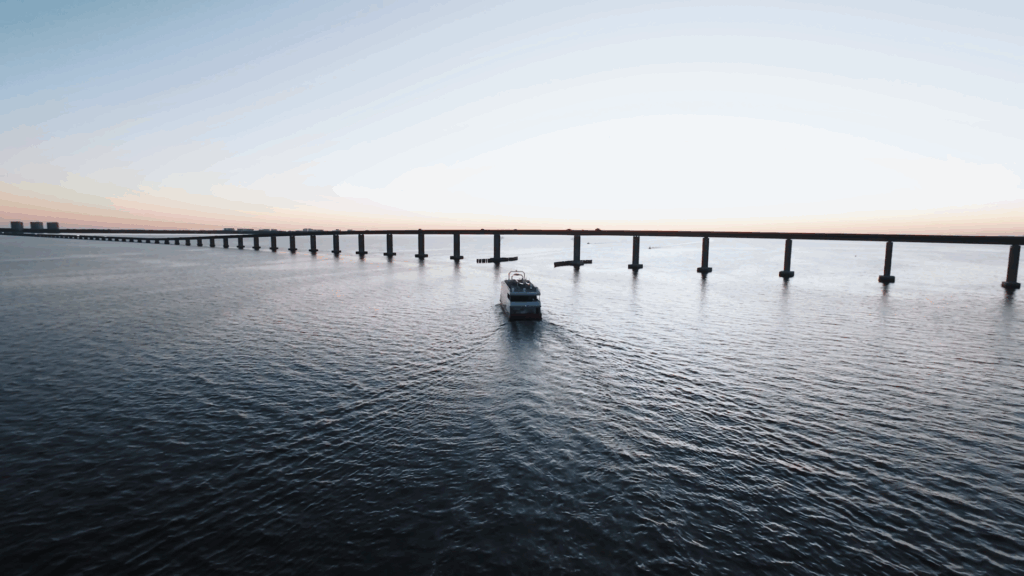
Sunset over the water is what happens when you face directly west and the sun drops into the water horizon with a golden reflection path stretching toward you. Notably, Gulf-front beaches on this coast don’t give you this—but the back bays do. Specifically, Wolf Bay, Cotton Bayou, Perdido Bay, Choctawhatchee Bay, and Pensacola Bay all have stretches that face west or southwest, and venues positioned on those waterlines produce the classic “sun sinking into the water” composition. For example, this is why bay-front venues like the Coastal Arts Center on Wolf Bay and The Port at Zeke’s on Cotton Bayou consistently produce some of the most dramatic sunset photography in the area—their orientation faces the sunset directly.
Why Side-Lighting Is Actually Ideal for Portraits
Photographers know this, but couples often don’t: the side-lighting that south-facing beaches naturally produce is considered the most flattering directional light for portraiture. Specifically, it creates the strongest sense that a subject has three dimensions—one side lit, the other in gentle shadow, with depth and texture revealed rather than flattened (Digital Photography School – Side Lighting).
When you face the water on this coast during golden hour, the setting sun illuminates you from the side. As a result, both the sky and your faces can be properly exposed in a single frame. No fill flash needed. No reflectors. Instead, just natural light doing exactly what it does best. For the classic backlit silhouette look, your photographer simply repositions you to face west along the shoreline—and both compositions are achievable within minutes on the same beach.
Sunset Times by Season (Central Time)
All times below are for the approximate 15th of each month in 2026 for Destin, FL. Importantly, the entire coast from Destin through Gulf Shores is within minutes of these times due to the nearly identical latitude.
| Month | Sunset (CT) | Golden Hour Start (~60 min before) | Blue Hour (~20–30 min after sunset) | Sunset Azimuth |
|---|---|---|---|---|
| January | 5:14 PM CST | ~4:14 PM | 5:14–5:44 PM | 247° WSW |
| February | 5:39 PM CST | ~4:39 PM | 5:39–6:09 PM | 256° WSW |
| March | 6:54 PM CDT | ~5:54 PM | 6:54–7:24 PM | 268° W |
| April | 7:13 PM CDT | ~6:13 PM | 7:13–7:43 PM | 280° WNW |
| May | 7:37 PM CDT | ~6:37 PM | 7:37–8:07 PM | 290° WNW |
| June | 7:50 PM CDT | ~6:50 PM | 7:50–8:20 PM | 296° WNW |
| July | 7:47 PM CDT | ~6:47 PM | 7:47–8:17 PM | 294° WNW |
| August | 7:23 PM CDT | ~6:23 PM | 7:23–7:53 PM | 284° WNW |
| September | 6:50 PM CDT | ~5:50 PM | 6:50–7:20 PM | 271° W |
| October | 6:19 PM CDT | ~5:19 PM | 6:19–6:49 PM | 259° WSW |
| November | 4:55 PM CST | ~3:55 PM | 4:55–5:25 PM | 249° WSW |
| December | 4:44 PM CST | ~3:44 PM | 4:44–5:14 PM | 244° WSW |
What the Three-Hour Annual Swing Means for Your Timeline
The annual swing is dramatic—over three hours between the earliest sunset (approximately 4:42 PM in early December) and the latest (approximately 7:52 PM in late June). However, this isn’t just an aesthetic detail. Rather, it’s scheduling math that directly affects your ceremony start time, your coverage hours, and the pace of your entire day. For your exact wedding date, confirm times at timeanddate.com or the NOAA Sunrise/Sunset Calculator.
Ceremony timing formula: Schedule your ceremony to end approximately 60–90 minutes before sunset. Specifically, this gives you roughly 30 minutes for the ceremony, 30 minutes for family formals and transition, and 45–60 minutes of dedicated golden-hour couple portraits ending at sunset. Additionally, blue-hour portraits follow for another 20–30 minutes after sunset. Indeed, multiple professional photographers confirm building 45–60 minutes exclusively for golden-hour portraits into the timeline. For a deeper look at how to build the rest of your day around this, see our full Gulf Coast wedding-day timeline guide.
Golden Hour and Blue Hour: What They Are and Why They Matter
Golden hour is the final 45–70 minutes before sunset, when the sun is between approximately 0 and 6 degrees above the horizon. At this angle, sunlight passes through a dramatically thicker layer of atmosphere than at midday, scattering shorter blue and violet wavelengths and allowing warm red and orange wavelengths to dominate. As a result, the color temperature drops from approximately 5,500K (neutral daylight) to roughly 2,500–3,500K (warm golden tones) (timeanddate.com – Golden Hour).
The increased atmospheric path also reduces direct light intensity and increases diffused skylight, narrowing the contrast between highlights and shadows. Consequently, the result is soft, even illumination with gentle shadows—nature’s version of a professional softbox. Skin tones glow rather than wash out. Deep shadows under eyes and chins disappear. Meanwhile, hair catches the low sun as a luminous rim of light. In addition, the sky fills with oranges, pinks, and purples that no artificial backdrop can replicate (Adobe – Golden Hour Photography).
At 30°N latitude (this coast), golden hour lasts approximately 45–55 minutes in winter (the sun drops more steeply) and 55–70 minutes in summer (the sun’s path crosses the horizon at a shallower angle). Therefore, the practical range across the year is 45–70 minutes—enough time for a dedicated portrait session if it’s protected in the timeline.
Blue Hour
Blue hour begins approximately 20–30 minutes after sunset, when the sun is 4 to 8 degrees below the horizon. At that point, the sky shifts from warm residual glow at the horizon to deep blue and indigo overhead—a natural two-tone backdrop created by ozone absorption of red wavelengths from residual sunlight. Consequently, color temperature climbs to approximately 9,000–12,000K (timeanddate.com – Blue Hour).
Blue hour lasts roughly 20–30 minutes at this latitude, and it’s increasingly valued by cinematographers and photographers for the moody, cinematic atmosphere it creates. Specifically, this is the window where string lights, candles, and ambient venue lighting become visible against the sky—the warm-versus-cool color contrast of amber fixtures against deep blue atmosphere that defines the most cinematic reception transitions. For couples investing in Gulf Coast wedding videography, blue hour is the window that produces the footage with the most emotional depth.
Practical application: Golden hour is for your signature couple portraits—the images that will hang on your wall. By contrast, blue hour is for the transition into your reception—the footage that opens the second act of your film. Ultimately, both should be protected in your timeline, and your photo and video team should know in advance which windows they’re working with on your specific date.
Which Season Produces the Best Sunsets?
Not all Gulf Coast sunsets are equal. Specifically, atmospheric conditions—humidity, cloud cover, air clarity, and post-storm dynamics—vary dramatically by season, and they directly affect how vivid and dramatic your sunset photographs will be. For a broader look at monthly climate and how it shapes wedding planning overall, see our guide to the best time of year to get married on the Gulf Coast.
Fall (October–November): The Best Season for Sunset Photography
October is the consensus pick among local photographers and the atmospheric data confirms it. Specifically, October has the fewest precipitation days of any month (approximately 6), the lowest average humidity (approximately 68%), and the highest percentage of clear or partly cloudy skies (65–67%). In addition, lower humidity produces crisper light and more saturated color. Notably, NOAA’s atmospheric science confirms that cleaner air in the lower atmosphere is the primary ingredient in vividly colored sunsets—and October delivers the cleanest air of any warm-weather month on this coast (NOAA SPC – The Science of Sunset Color).
November continues the pattern with slightly more precipitation but still-clear skies and comfortable temperatures. Although hurricane season officially extends through November 30, after late October, the risk drops substantially.
Winter (December–February): Dramatic Post-Front Skies and Exceptionally Clean Light
Cold fronts move through approximately every 5–10 days during winter, bringing cloud buildup, rain during passage, then dramatically clearing skies with dry, crisp air. Specifically, post-frontal dew points can drop into the 30s and 40s°F, creating exceptionally clean atmosphere. Notably, NOAA confirms that late fall and winter are the seasons for the best sunsets in the eastern United States. In addition, the cold fronts also bring cirrus and altocumulus clouds—the ideal cloud types for dramatic sunset color, acting as the canvas that catches and reflects warm light.
The trade-off: sunsets arrive significantly earlier (4:44–5:39 PM), requiring earlier ceremony starts and compressing the day. However, on a clear post-front evening, winter sunset light on this coast is as rich and vivid as anything you’ll see anywhere in the world.
Spring (March–May): Soft Golden Glow with Pollen Haze
Tree pollen from oak, pine, maple, and cedar peaks in March through April, creating a visible haze across the coast. As a result, this haze diffuses light and creates a soft, golden glow—flattering for skin tones and dreamy in quality, but muting the vivid sunset colors that fall and winter produce. Some photographers love the ethereal quality; others prefer the crispness of clearer months. Notably, May is the driest month on the coast (approximately 3.22 inches, 6 precipitation days), but thunderstorm season begins ramping up.
Summer (June–August): Dramatic When Storms Clear, But Least Reliable
Sea-breeze-driven thunderstorms are the defining weather feature of Gulf Coast summers, typically developing between 2 and 5 PM and dissipating as the sun angle drops. With sunsets around 7:30–8:00 PM, many storms do clear in time—and post-storm clearing can produce exceptionally dramatic skies as rain scrubs particles from the atmosphere and residual high clouds catch the sunset color. However, it is not guaranteed. For instance, July is the cloudiest month (approximately 59% overcast) with the most precipitation days (11). Furthermore, high humidity mutes sunset colors on non-storm days. Overall, summer sunsets are a gamble—when they hit, they’re extraordinary, but they’re the least reliable season for consistent quality.
Seasonal Sunset Quality Summary
| Season | Sunset Reliability | Color Vibrancy | Best For |
|---|---|---|---|
| Fall (Oct–Nov) | Highest | Highest | The consensus best season for sunset photography |
| Winter (Dec–Feb) | High (post-front days) | Exceptional when clear | Dramatic post-front skies; richest color |
| Spring (Mar–May) | Good | Moderate (pollen softens) | Soft golden glow; dreamy quality |
| Summer (Jun–Aug) | Least reliable | Variable | Dramatic post-storm clearing; longest golden hours |
The 12 Best Sunset Venues on the Gulf Coast
These venues were selected specifically for the strength of their sunset orientation—where the ceremony or portrait space faces, how the western horizon is accessed, and what makes the sunset view distinctive at each property. For the broader photography-first venue selection across all categories, see our pillar guide to the best Gulf Coast wedding venues for photography and film.
Gulf-Front Venues: Sunset Along the Water
These venues deliver the classic Gulf Coast beach-wedding sunset—the sun setting at an angle to your right while warm side-lighting wraps across your faces.
Henderson Beach Resort — Destin, FL
The resort’s western neighbor is Henderson Beach State Park—200 acres of undeveloped nature preserve that creates a completely unobstructed western horizon. Specifically, the Sunset Terrace is a dedicated, purpose-named ceremony space designed for sunset timing, with a multi-level layout overlooking the Gulf. Additionally, the Rooftop Terrace provides the widest panoramic view in Destin. Capacity ranges from 40 to 520 depending on the space. Notably, the resort owns 300 feet of private beach, with the state park adding 1.3 miles of pristine coastline to the west (Henderson Beach Resort).
Vue on 30A — Santa Rosa Beach, FL
A Gulf-front restaurant venue whose name literally means “view.” Specifically, floor-to-ceiling windows capture panoramic water and sky. Notably, Vue on 30A won “Best Place to Watch a Sunset” by Destin Magazine and “Best Wedding Venue” by Visit South Walton. In addition, the Full Club Level accommodates 70–230 guests. Beach ceremony access directly below the restaurant. Also, in-house catering with award-winning Gulf seafood (Vue on 30A).
Hilton Sandestin Beach — Miramar Beach, FL
The largest full-service beachfront resort in the area, featuring a purpose-named Sunset Deck—8,000 square feet of elevated outdoor space accommodating up to 200 banquet-style guests with direct Gulf sunset views. Additionally, two additional outdoor decks (Barefoot’s at 8,000 square feet and Sunrise at 5,500 square feet) bring total outdoor deck space to 22,500 square feet. Importantly, the resort explicitly offers to time ceremonies with the sunset. Indoor ballrooms total 40,000 square feet (Hilton Sandestin Beach).
The Lodge at Gulf State Park — Gulf Shores, AL
Located directly on the Gulf inside the 6,150-acre state park. Specifically, the Dunes Terrace—5,500 square feet of Gulf-facing outdoor space off the ballroom—is the signature sunset ceremony and cocktail environment. Notably, the 12,160-square-foot ballroom with floor-to-ceiling Gulf panorama windows is the largest beach-view ballroom on the Gulf Coast, accommodating up to 1,000 guests. In addition, fire pit areas provide post-reception gathering with lingering twilight views. Finally, two boardwalks give direct beach access for sand ceremonies (The Lodge at Gulf State Park).
Bay-Front and Harbor Venues: Sunset Over the Water
These venues face west toward the sunset rather than south toward the Gulf—meaning the sun drops directly into the water horizon in front of you, creating the classic golden reflection path and the most dramatic sunset-over-water compositions.
Coastal Arts Center of Orange Beach — Wolf Bay
The strongest sunset orientation of any venue in this guide. Specifically, Wolf Bay opens to the west and southwest, providing direct, unobstructed sunset-over-water views. Additionally, the waterfront stage overlooks the bay with the sunset directly behind, and a pier extends into Wolf Bay for intimate sunset portraits. Notably, photographers consistently single out this venue for its sunset views. Furthermore, the 10,000-square-foot fine art gallery creates an indoor reception unlike any resort. Capacity 150–250 guests. City-owned with open catering policy at $3,000–$7,000 per wedding (Coastal Arts Center of Orange Beach).
The Port at Zeke’s — Cotton Bayou, Orange Beach
Cotton Bayou opens to the west and northwest toward the Intracoastal Waterway, providing direct sunset-over-water views—one of the strongest sunset orientations on the Alabama coast. Notably, the venue markets itself as having “some of the most beautiful sunsets on the Gulf Coast of Alabama.” In addition, the 1,500-square-foot outdoor observation deck is the primary ceremony and cocktail space with panoramic sunset views. Furthermore, floor-to-ceiling windows in the 7,000-square-foot indoor space ensure water views for all guests. Also, outside catering is accommodated (The Port at Zeke’s).
Palafox Wharf Waterfront — Pensacola Bay
The only privately owned waterfront venue in Pensacola, directly on Pensacola Bay facing the western horizon. Specifically, it features a waterfront deck, pier and dock (boat access for grand exits), and a large green lawn—all overlooking the bay toward the setting sun. Additionally, the renovated 1880 historic building interior has high ceilings, skylights, exposed brick, and café lighting. Capacity 20–200 guests. Starting at approximately $6,000. Palafox Wharf also appears in our coverage of indoor-outdoor wedding venues on the Emerald Coast (Palafox Wharf).
Emerald Grande at HarborWalk Village — Destin Harbor
Positioned on Destin Harbor overlooking the East Pass where the harbor meets the Gulf, with western-facing views over wide harbor waters toward the setting sun. Specifically, the Sunset Deck (75 guests) and Captain’s Deck (180 guests, elevated) are the signature sunset spaces. Notably, HarborWalk Village fireworks can coincide with wedding nights. Venue facility fee starts at $4,000 off-season, $6,000 peak season (Emerald Grande at HarborWalk Village).
Dual-Waterfront and Elevated Venues
These venues offer unique angles—dual coastlines, rooftop elevation, or mobile positioning—that provide sunset options ground-level Gulf-front venues cannot match.
Portofino Island Resort — Pensacola Beach
Portofino is the only venue in this guide with dual waterfront access—Gulf-front on one side, Santa Rosa Sound on the other. Specifically, the Sound side faces northwest, providing direct sunset-over-water views from the Lower Pool Deck—the prime sunset ceremony location. Additionally, the Gulf side offers classic beachfront on 8 miles of protected National Seashore. Capacity 25–250 guests. Starting at approximately $6,073 for 50 guests (Portofino Island Resort).
The Pearl Hotel — Rosemary Beach
The Havana Beach Rooftop Deck provides an elevated, unobstructed Gulf vantage point—one of the few rooftop ceremony options on 30A. Notably, the elevation separates the couple from beach-level visual clutter and places the sky as a dominant backdrop. Additionally, the West Indies–style boutique hotel features copper lanterns, fireside lounges, and the Hemingway Room with western-facing floor-to-ceiling windows. Capacity 75 ceremony, 100 reception (The Pearl Hotel).
SOLARIS Yacht — Choctawhatchee Bay (Sandestin)
SOLARIS is the only mobile venue in this guide. Specifically, the 125-foot yacht cruises Choctawhatchee Bay and can position for optimal sunset views on open water—effectively 360-degree sunset access. Additionally, the open-air Sky Deck on the third level is the primary ceremony space with unobstructed horizon views in every direction. Notably, three decks, 5,300 square feet of indoor-outdoor space, private bridal suite, full galley kitchen. Up to 149 guests. All-inclusive packages starting at approximately $2,500 (SOLARIS / SunQuest Cruises).
Heron Pointe at The Wharf — Orange Beach
A Southern estate aesthetic with wrap-around porches overlooking the Intracoastal Waterway within The Wharf entertainment district. Specifically, the waterway runs roughly east-west, and the southern porches provide marina and bay views with golden-hour reflections. Additionally, proximity to The Wharf Marina offers additional waterfront portrait locations. Up to 400 guests. Notably, the venue hosts 140+ events per year (Heron Pointe at The Wharf).
Why Elevation Changes Everything
Venues with rooftop decks, elevated terraces, or pier access extending over water provide distinct advantages for sunset photography that ground-level beach ceremonies can’t match.
Even a 20-foot elevation gain pushes the visible horizon further—at eye level on a flat beach, the horizon is approximately 2.9 miles away; at 30 feet, it extends to roughly 6.7 miles. As a result, the sun stays visible longer, extending your shooting window by several precious minutes. Additionally, elevation allows photographers to compose with both the sky above and reflections below, creating layered images impossible at ground level. Furthermore, it separates the couple from beach-level visual clutter—umbrellas, other beachgoers, sand structures—placing the sky as a clean, dramatic backdrop.
The venues with the strongest elevated features for sunset photography: The Pearl Hotel’s Havana Beach Rooftop Deck (approximately 40–50 feet, fourth floor), Henderson Beach Resort’s Rooftop Terrace and multi-level Sunset Terrace, Emerald Grande’s Captain’s Deck (approximately 30–40 feet above the harbor), the SOLARIS Sky Deck (approximately 30 feet above waterline with 360-degree positioning), Hilton Sandestin’s 8,000-square-foot Sunset Deck, The Lodge’s 5,500-square-foot Dunes Terrace, and The Port at Zeke’s 1,500-square-foot observation deck.
Additionally, the Coastal Arts Center’s pier extending into Wolf Bay and Palafox Wharf’s pier and dock on Pensacola Bay offer a different kind of elevated advantage—extending over water to create sunset portraits surrounded by reflections on every side, with the sun setting directly ahead.
Timing Your Day Around the Light
The sunset is your anchor. Everything else in your timeline flows from it. Here’s the framework we use with every couple.
Step 1: Look Up the Exact Sunset Time for Your Wedding Date
Use the table above as a baseline, then confirm at timeanddate.com or the NOAA calculator.
Step 2: Schedule Your Ceremony to End 60–90 Minutes Before Sunset
A 30-minute ceremony that concludes 75 minutes before sunset gives you a comfortable 15-minute transition into family formals, then a full 45–60 minute golden-hour portrait session ending right at sunset.
Step 3: Protect the Golden-Hour Window
This is the 45–70 minutes before sunset when the light is at its warmest and most flattering. Therefore, your couple portrait session should fill this entire window. No cocktail hour activities, no family photos, no logistics—just the two of you, your photo and video team, and the light.
Step 4: Plan for Blue Hour
The 20–30 minutes after sunset produce a completely different visual—deep blue sky, warm ambient lighting becoming visible, and a moody cinematic quality that’s increasingly valued in wedding films. Additionally, if your venue has string lights, candles, or architectural lighting, this is the window where that ambient warmth contrasts against the blue sky for the most dramatic effect.
Step 5: Choose Your Season Intentionally
If vivid, dramatic sunset color is a priority, October and November are the strongest months. Meanwhile, winter post-front evenings produce exceptional clarity. In contrast, spring offers soft golden glow. Finally, summer brings the longest golden hours but the least reliable conditions.
At White Sands Weddings, we build every timeline around this framework—because the light is the single most important variable in your photos and film, and the venues on this coast deserve to be captured at their absolute best.
Ready to plan your sunset? Check your date and let’s build a timeline around the light your day deserves.
Want to see what Gulf Coast sunsets look like in a wedding gallery? Browse our recent gallery of Gulf Coast weddings to see the light in action.
Matthew Oakes
Founder & Filmmaker, White Sands Weddings
info@whitesandsweddings.com
Sources and Further Reading
Solar Geometry and Sunset Science
- timeanddate.com – Destin Sunrise/Sunset — verified sunset times and azimuth data
- NOAA Sunrise/Sunset Calculator — exact sunset for any date and location
- NOAA SPC – The Science of Sunset Color (Corfidi) — atmospheric factors in sunset vibrancy
- timeanddate.com – Golden Hour — golden hour definition and duration
- timeanddate.com – Blue Hour — blue hour definition
- Adobe – Golden Hour Photography — technique and science
- Digital Photography School – Side Lighting — why side-lighting creates dimensional portraits
Venues
- Henderson Beach Resort
- Vue on 30A
- The Pearl Hotel
- Emerald Grande at HarborWalk Village
- SOLARIS / SunQuest Cruises
- Palafox Wharf Waterfront
- Portofino Island Resort
- The Port at Zeke’s
- Heron Pointe at The Wharf
- The Lodge at Gulf State Park
- Coastal Arts Center of Orange Beach
- Hilton Sandestin Beach
Climate and Weather Data
- US Climate Data – Destin — 1991–2020 precipitation and temperature normals
- Weather Spark – Destin — cloud cover and clear sky percentages by month


